









The
Wide-field
Spectroscopic
Telescope
Wide-field
Spectroscopic
Telescope
Pushing the Boundaries of
Spectroscopic Surveys
THE WST DEEP DIVE
Unpacking the project’s core pillars
The WST will be pivotal, in synergy with other major astronomical facilities in the 2040s, to tackle some of the key open questions in modern astrophysics.
Astronomy has entered the era of data-driven discovery. To fully exploit this wealth of multi-wavelength information, spectroscopy is essential, as it can add further dimensions.
The WST Operations Work Package is dedicated to designing the science-driven operational framework and data flow architecture that will enable WST to deliver its ambitious scientific goals.
The WST considers sustainability a core value guiding both the development of the facility and the activities of the consortium. A dedicated cross-disciplinary group supports this commitment by developing guidelines, particularly for the design and construction phases.
Observatory
The Facility
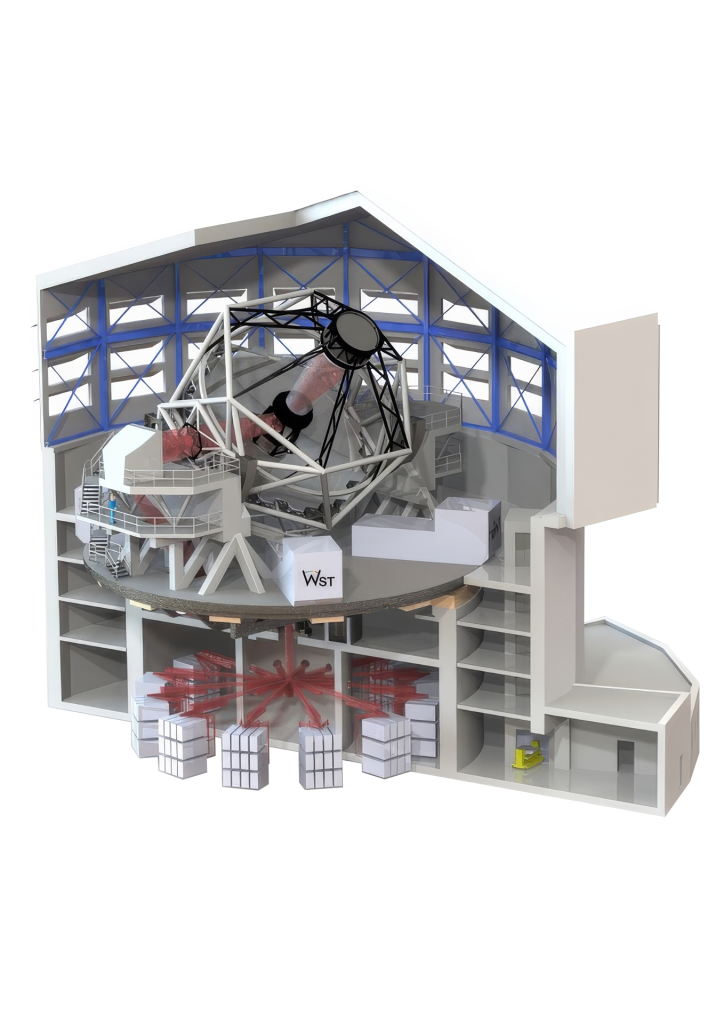
An innovative 12-m class wide-field spectroscopic telescope (WST) with simultaneous operation of a large field-of-view (FoV, 3 sq. degree) and high multiplex (30,000) multi-object spectrograph facility with both medium and high resolution modes (MOS), and a giant panoramic (3×3 sq. arcmin) integral field spectrograph (IFS).
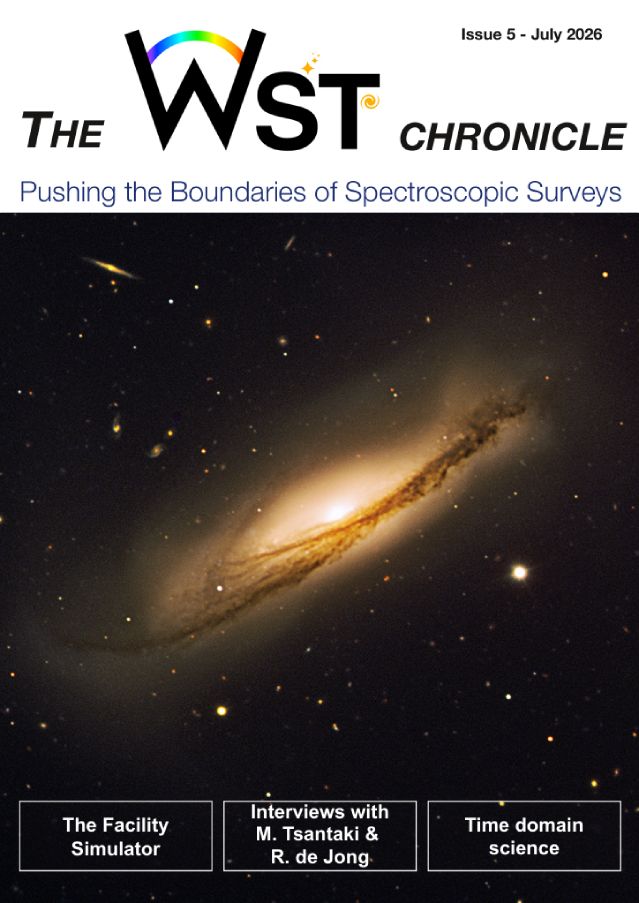
The WST Chronicle
The WST Chronicle is a tri-monthly magazine that provides a platform for communicating progress within the WST consortium while serving as a bridge to the wider community.
THE WST People
MEET THE TEAM BEHIND THE PROJECT
THE WST Consortium
Research institutes & universities over 12 countries
The WST consortium brings together the Horizon Consortium, comprising 23 research institutes, and a much broader Science Team. All consortium members adhere to the WST Code of Conduct and Publication Policy.
Join us
The WST project is committed to an open-science policy, allowing any professional astronomer to join the Science Team.
Frequently asked questions
The great quests of modern astrophysics and cosmology
Is the accelerated expansion of the Universe due to an unknown form of energy or to a modification of General Relativity on large scales?
What signatures of new physics from inflation and the early Universe are present in the clustering of high redshift galaxies?
How do black holes form and grow over cosmic time?
What is the interplay between dark, stellar, and gaseous material in galaxies, and how does primordial and metal-enriched gas flow in and out of galaxies at various scales during different epochs?
What is the detailed formation and accretion history of the Milky Way, its populations, and its satellites?
The WST main challenges
The great quests of modern astrophysics and cosmology
Item content. Click the edit button to change this text.
Nobis atque id hic neque possimus voluptatum voluptatibus tenetur, perspiciatis consequuntur. Lorem ipsum dolor sit amet, consectetur adipisicing elit. Minima incidunt voluptates nemo, dolor optio quia architecto quis delectus perspiciatis.
We use cookies that are essential for accessing our websites and using our services. We also use cookies to analyse, measure and improve our websites’ performance, to enable content sharing via social media and to display media content hosted on third-party platforms.
You can manage your cookie preferences and find out more by visiting 'Cookie Settings and Policy'.