
The WST will fill a critical gap in the global astronomical infrastructure of the 2040s.

By delivering unprecedented spectroscopic mapping of the Universe, the WST will fundamentally reshape the scientific landscape and unlock entirely new discovery space for both current and future ground- and space-based observatories. Its surveys will not only maximise the scientific return of major facilities such as the ELT, Rubin/LSST, Gaia, Euclid, Roman, SKAO, and gravitational wave interferometers, but will also enable science that is simply inaccessible without the WST.

A few examples are described below.

The Gaia MISSION

The ESA Gaia mission has been a gamechanger for our comprehension of the assembly and accretion history of the Milky Way, providing positions, distances, motions, and photometry of nearly two billion stars with unprecedented precision. The final Gaia data release is expected by the start of the next decade; however, even in the 2040s a major fraction of the stars with exquisite astrometry from Gaia will still miss the fundamental spectroscopic information providing detailed elemental abundances and radial velocities. For the brighter stars, the combination of R=40,000, high-multiplex and large collecting area make WST uniquely positioned to combine the precise chemistry and kinematics of the stellar populations in the Milky Way; for the fainter ones, at larger distances, the low resolution multi-object spectrograph (MOS) will still allow radial velocities and metallicities to be measured for tens of millions of stars, enabling a detailed reconstruction of formation history of our Galaxy and its components.

Radio, High-Energy, Gravitational Waves and Particle Messengers

Multi-messenger astronomy will be mainstream in the WST era, and entire facilities will be dedicated to rapidly evolving phenomena, spanning energy ranges from TeV (CTA) through μeV (SKAO). Next-generation gravitational wave observatories such as the Einstein Telescope, Cosmic Explorer, and the ESA’s LISA mission, along with astro-particle detectors like IceCube or Antares, will deliver real time, full-sky multi-messenger alerts. The unique combination of field of view, sensitivity, and multiplexing of the WST will be crucial to detect and characterise the electromagnetic counterparts of such events.

The WST will have remarkable synergies with radio facilities that will be fully operational in the 2040s, such as SKAO and ngVLA. The MOS of the WST will be uniquely placed to understand the spectral properties and redshift distribution of the new population of sources that will be discovered with at radio wavelengths, therefore providing valuable information about large-scale structure formation, galaxy evolution, and the origin of the large-scale coherent magnetic fields in galaxies over cosmic time.

Future X-ray missions, such as NewAthena, will characterise the hot circum-galactic medium surrounding galaxies in a wide redshift range. The IFS of the WST will be uniquely suited to complement the mapping of the ionised gas on similar scales, therefore providing the panoramic multi-phase view of the gas that is a key element to understand how baryons flow in and out galaxies, the so-called baryon cycle.

  1. Bisero et al. 2026, A&A 705, 54
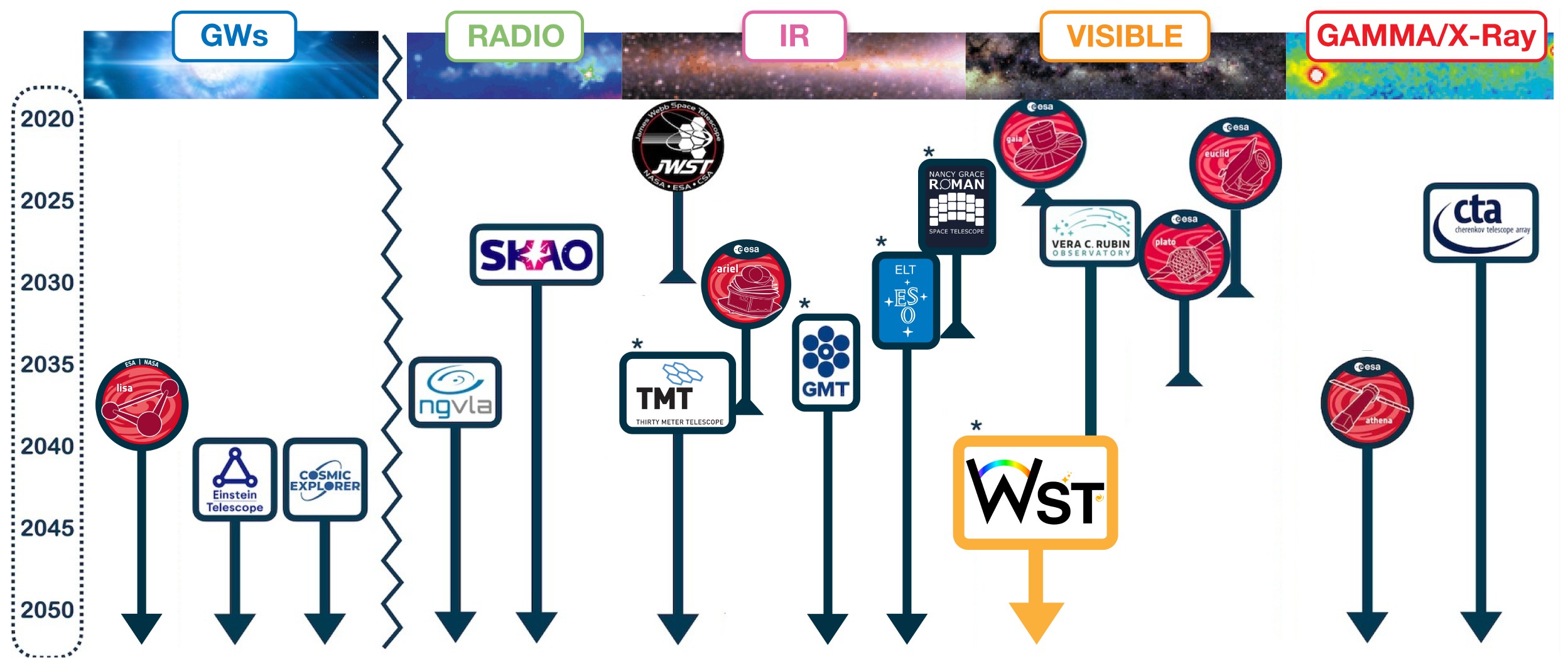
Timeline chart showing the development of astronomical observatories from 2020 to 2050. Categories include GWs, RADIO, IR, VISIBLE, and GAMMA/X-Ray. Each observatory, like SKA, JWST, TMT and the WST, is marked by an icon and positioned under its respective spectrum category on the timeline, illustrating planned operational start years.

A graphical representation of the current and upcoming major astronomical facilities. The facility marked with an asterisk (e.g., ELT, TMT, GMT) have been listed in the spectral range they cover the most for visual purposes, but they also partly cover other bands. The duration of space missions reflects the publicly available nominal values.
WST will have strong synergies with many of those, filling in a gap in the current landscape. Credits: Camilla Danielski. Background images: ESO/L. Calçada/M. Kornmesser; NASA Godard SFC.

Next section

How do supermassive black holes form, and what is the black hole mass function? WST’s statistical power will constrain the full black hole population, intermediate-mass black holes and their impact on galaxies.

Acronyms

TECHNICAL

WST: Wide-field Spectroscopic Telescope

FoV: Field-of-View

IFS: Integral Field Spectrograph

IFU: Integral Field Unit

MOS: Multi-Object Spectrograph

MOS-HR: High-resolution Multi-Object Spectrograph

MOS-LR: Low-resolution Multi-Object Spectrograph

ToO: Targets of Opportunity

INSTITUTES & UNIVERSITIES

AIP: Leibniz Institute for Astrophysics Potsdam

ANU/Astralis: The Australian National University / Astralis

CRAL/CNRS: Centre de Recherche Astrophysique de Lyon / French National Centre for Scientific Research

EPFL: Swiss Federal Institute of Technology in Lausanne

ESO: European Southern Observatory

IA/CAUP: Institute of Astrophysics and Space Sciences / Centre for Astrophysics of the University of Porto

IASF-MI/INAF: Institute for Space Astrophysics and Cosmic Physics of Milan / National Institute for Astrophysics

IP2I/CNRS: Institute of Physics of the Two Infinities of Lyon / French National Centre for Scientific Research

IRFU/CEA: Institute for Research into the Fundamental Laws of the Universe / French Alternative Energies and Atomic Energy Commission

Lagrange/CNRS: Lagrange Laboratory / French National Centre for Scientific Research

LAM/CNRS: Marseille Astrophysics Laboratory / French National Centre for Scientific Research

MAQC/Astralis: Macquarie University / Astralis

NCAC: Nicolaus Copernicus Astronomical Center

OAArcetri/INAF: Arcetri Astrophysical Observatory / National Institute for Astrophysics

OABrera/INAF:Brera Astronomical Observatory / National Institute for Astrophysics

OACapodimonte/INAF: Capodimonte Astronomical Observatory / National Institute for Astrophysics

OASBologna/INAF:Bologna Observatory of Astrophysics and Space Science / National Institute for Astrophysics

UKRI: UK Research and Innovation

UNIBO: University of Bologna

UNIGRO/NOVA: University of Groningen / The Netherlands Research School for Astronomy

UNISYD: The University of Sydney

UNIVIE: University of Vienna

UWA: The University of Western Australia

Edit Template

Join the community

ue-logo-h
This project has received funding from the European Union Horizon Europe Research and Innovation Action under grant agreement no. 101183153 -WST.
Views and opinions expressed are however those of the author(s) only and do not necessarily reflect those of the European Union or European Research Executive Agency (REA). Neither the European Union nor the granting authority can be held responsible for them.

Acronyms

TECHNICAL

WST: Wide-field Spectroscopic Telescope

FoV: Field-of-View

IFS: Integral Field Spectrograph

IFU: Integral Field Unit

MOS: Multi-Object Spectrograph

MOS-HR: High-resolution Multi-Object Spectrograph

MOS-LR: Low-resolution Multi-Object Spectrograph

ToO: Targets of Opportunity

INSTITUTES & UNIVERSITIES

AIP: Leibniz Institute for Astrophysics Potsdam

ANU/Astralis: The Australian National University / Astralis

CRAL/CNRS: Centre de Recherche Astrophysique de Lyon / French National Centre for Scientific Research

EPFL: Swiss Federal Institute of Technology in Lausanne

ESO: European Southern Observatory

IA/CAUP: Institute of Astrophysics and Space Sciences / Centre for Astrophysics of the University of Porto

IASF-MI/INAF: Institute for Space Astrophysics and Cosmic Physics of Milan / National Institute for Astrophysics

IP2I/CNRS: Institute of Physics of the Two Infinities of Lyon / French National Centre for Scientific Research

IRFU/CEA: Institute for Research into the Fundamental Laws of the Universe / French Alternative Energies and Atomic Energy Commission

Lagrange/CNRS: Lagrange Laboratory / French National Centre for Scientific Research

LAM/CNRS: Marseille Astrophysics Laboratory / French National Centre for Scientific Research

MAQC/Astralis: Macquarie University / Astralis

NCAC: Nicolaus Copernicus Astronomical Center

OAArcetri/INAF: Arcetri Astrophysical Observatory / National Institute for Astrophysics

OABrera/INAF:Brera Astronomical Observatory / National Institute for Astrophysics

OACapodimonte/INAF: Capodimonte Astronomical Observatory / National Institute for Astrophysics

OASBologna/INAF:Bologna Observatory of Astrophysics and Space Science / National Institute for Astrophysics

UKRI: UK Research and Innovation

UNIBO: University of Bologna

UNIGRO/NOVA: University of Groningen / The Netherlands Research School for Astronomy

UNISYD: The University of Sydney

UNIVIE: University of Vienna

UWA: The University of Western Australia

Edit Template
ue-logo-h
This project has received funding from the European Union Horizon Europe Research and Innovation Action under grant agreement no. 101183153 -WST.
Views and opinions expressed are however those of the author(s) only and do not necessarily reflect those of the European Union or European Research Executive Agency (REA). Neither the European Union nor the granting authority can be held responsible for them.