

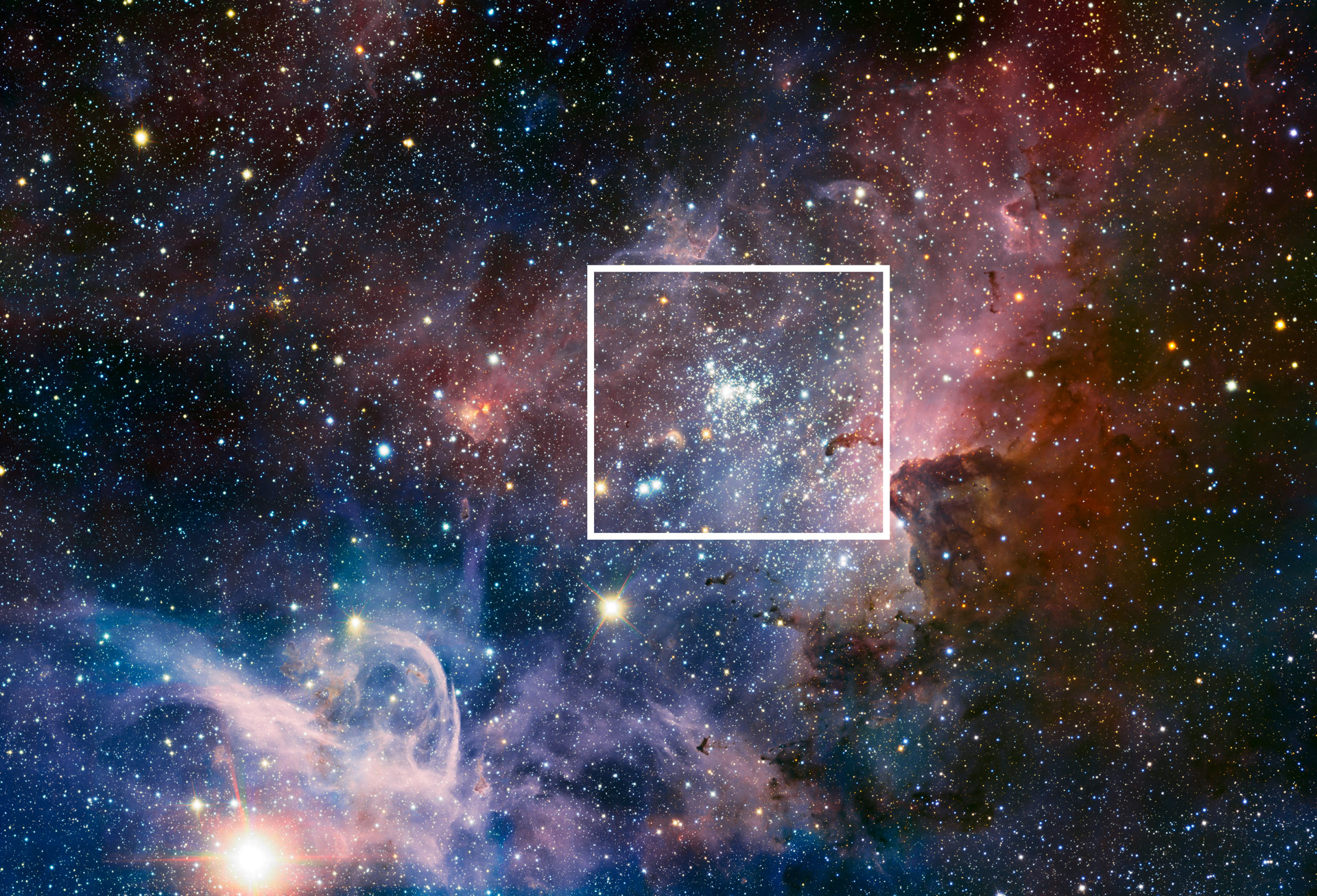

Tracing star and planet formation in different environments
Understanding how stars and planets form is fundamental to addressing several open questions of modern astrophysics, yet we do not have a full comprehension of the process. This impacts multiple fields, from the evolution of galaxies to the origin of our Solar System.
Although numerous space- and ground-based facilities across multiple wavelength regimes are addressing this question through diverse approaches, the WST will provide complementary yet essential ways to investigate this topic.
Small bodies as a probe of planetary evolution
Surveying planet-hosting stars in different environments
Advancing from the discovery of a few thousand exoplanets to tens of thousands by 2040, the field faces a new generation of questions. The formation and evolution of planetary systems cannot be understood in isolation from their stellar and Galactic environment. One of the most pressing questions in the field is to understand the role of the environment in formation and diversity of planetary systems.
The WST will perform a large-scale, high-resolution spectroscopic survey of planet-host stars and white dwarfs, spanning a broad range of Galactic environments. The WST’s unique combination of high resolution, high multiplexing, and large aperture, will allow the homogeneous determination of stellar parameters, elemental abundances, ages, and Galactic properties to infer their birth origin enabling robust statistical analyses across stellar populations.
The WST will deliver a high-precision dataset that no existing or planned facility can provide, reaching fainter magnitudes than ever before. This survey will timely complement ongoing and upcoming space missions (Gaia, TESS, PLATO, Roman). The WST will provide the most complete chemical census of planet-hosting stars and white dwarfs in high resolution to date, an essential reference for models of planet formation, and evolution and will cement WST as a cornerstone facility for exoplanet demographics.
Charting millions of young stars
Synergies
The WST will fill a critical gap in the global astronomical infrastructure of the 2040s.
The WST is uniquely powerful to advance key open questions in the context of stellar physics, evolution, and nucleosynthesis.
We use cookies that are essential for accessing our websites and using our services. We also use cookies to analyse, measure and improve our websites’ performance, to enable content sharing via social media and to display media content hosted on third-party platforms.
You can manage your cookie preferences and find out more by visiting 'Cookie Settings and Policy'.
Exoplanets, Stars, and the Milky Way with the WST
Issue #3 The WST Chronicle