

Stars, their end-points, feedback, and elements production

Understanding how stars live, die, shape their surroundings, and enrich the interstellar medium lies at the heart of almost every major question in astrophysics.
The WST is uniquely powerful to advance key open questions in the context of stellar physics, evolution, and nucleosynthesis, by capturing the detailed chemical compositions, motions, and properties of vast and diverse stellar populations across galaxies.

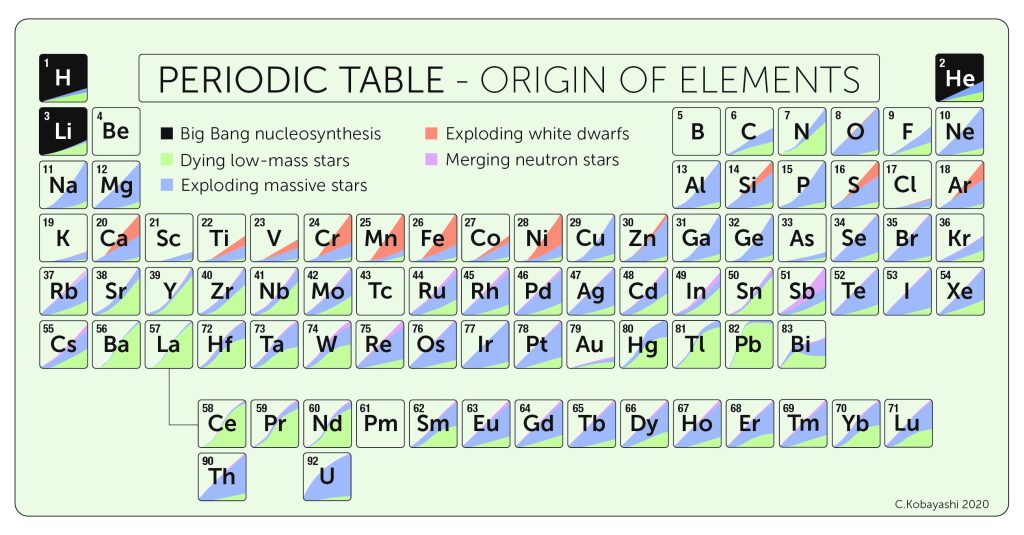
Periodic table showing the origins of elements. Colors indicate sources: Big Bang, dying stars, massive stars, white dwarfs, and neutron stars.

First stars

Very metal-poor massive stars in the Local Group are the best available proxies for the Universe’s first stars, which are fundamental for modelling the epoch of reionization and the early evolution of galaxies.

However, the evolution of these objects remains largely unconstrained, mainly due to the scarcity of observational data. The WST introduces a revolutionary capability to resolve and study stellar populations in low-metallicity galaxies, pushing beyond the metallicity and distance limits set by the Magellanic Clouds largely unconstrained, mainly due to the scarcity of observational data. The WST introduces a revolutionary capability to resolve and study stellar populations in low-metallicity galaxies, pushing beyond the metallicity and distance limits set by the Magellanic Clouds.

The WST IFS will systematically map the massive stellar populations of several galaxies in the Local Group, also covering supernova or gamma ray burst progenitors; this will allow, among others, the investigation of the role of metallicity in the evolution of massive stars and the connection to the formation and evolution of the first stars, as well as to explore the interplay/feedback between the most massive stars in these galaxies and the interstellar medium.

Binary systems and compact objects

The WST IFS and low-resolution MOS will allow the first vast survey of massive star clusters across a wide range of ages, observing 100,000 stars per cluster, to detect and characterise binary stars. This will revolutionize our understanding of binary physics and place tight observational constraints on the outcome of rare evolutionary phases. In particular, these surveys will allow tracing the survival of black holes and neutron stars inside the clusters across a Hubble time, with a strong impact on the interpretation of the data provided by the next generation of gravitational wave detectors.

The WST MOS, with both modes, will be used to conduct an unprecedented survey of white dwarfs (WDs -the end stage of stellar evolution for the vast majority of stars), much fainter than those covered by 4MOST, to obtain phase-resolved observations with sufficiently short exposure times to adequately sample the orbital phase for short-period compact binaries. This will allow constraining the models of binary evolution, testing the physics of the accretion discs, unveiling the population of type-I Supernovae progenitors, and characterising LISA’s verification binaries.

The origin of elements

Stellar abundances encode the nucleosynthetic yields of core-collapse and Type Ia supernovae (SNIa), asymptotic giant branch (AGB) stars, and kilonovae. Full comprehension of the origin of elements indeed requires tracing all the nucleosynthetic pathways and the underlying physical processes.

The WST, with the high-resolution MOS and IFS, will map abundance patterns for millions of stars across different environments in the Milky Way, as well as perform the first systematic abundance surveys of individual stars in Local Group dwarf galaxies. This will secure homogeneous individual abundances for a large variety of chemical elements, not only reaching distant populations, but also adding new key and precise information.

For example, the WST will allow the precise measurements of heavy elements, whose spectral lines are too weak or outside the wavelength range covered by current or planned large scale surveys. The WST high resolution surveys in blue wavelength regions will transform these studies and will quantify the relative importance and timescale of the various sources of neutron-capture elements, such as kilonovae, different types of supernovae, and evolved stars.

The nucleosynthesis of SNIa is another key area where the WST will provide unique and detailed insights. Precise abundances for elements produced by SNIa will be put in the context of the history of star formation and chemical enrichment of all Galactic populations. This will maximise our ability to connect abundance variations with the local properties and disentangle how the many subtypes of SNIa contribute to the chemical enrichment in a galaxy.

Similarly, in Local Group galaxies the WST IFS will obtain resolved spectroscopy and individual abundance measurements for red giant stars in crowded dwarf galaxy centres, while it will secure high-precision individual abundances for outer dwarf galaxy region red giant stars with MOS-HR, anchoring the abundance scale. This will be a panoramic atlas of element abundance planes across Local Group dwarfs, directly testing whether abundance dimensionalities and enrichment channels are universal or environment dependent.

IMMAGINE

Synergies

The WST will fill a critical gap in the global astronomical infrastructure of the 2040s.

Next section

Many objects in the Universe are moving, flaring, and transforming — and every change tells a story.

Acronyms

TECHNICAL

WST: Wide-field Spectroscopic Telescope

FoV: Field-of-View

IFS: Integral Field Spectrograph

IFU: Integral Field Unit

MOS: Multi-Object Spectrograph

MOS-HR: High-resolution Multi-Object Spectrograph

MOS-LR: Low-resolution Multi-Object Spectrograph

ToO: Targets of Opportunity

INSTITUTES & UNIVERSITIES

AIP: Leibniz Institute for Astrophysics Potsdam

ANU/Astralis: The Australian National University / Astralis

CRAL/CNRS: Centre de Recherche Astrophysique de Lyon / French National Centre for Scientific Research

EPFL: Swiss Federal Institute of Technology in Lausanne

ESO: European Southern Observatory

IA/CAUP: Institute of Astrophysics and Space Sciences / Centre for Astrophysics of the University of Porto

IASF-MI/INAF: Institute for Space Astrophysics and Cosmic Physics of Milan / National Institute for Astrophysics

IP2I/CNRS: Institute of Physics of the Two Infinities of Lyon / French National Centre for Scientific Research

IRFU/CEA: Institute for Research into the Fundamental Laws of the Universe / French Alternative Energies and Atomic Energy Commission

Lagrange/CNRS: Lagrange Laboratory / French National Centre for Scientific Research

LAM/CNRS: Marseille Astrophysics Laboratory / French National Centre for Scientific Research

MAQC/Astralis: Macquarie University / Astralis

NCAC: Nicolaus Copernicus Astronomical Center

OAArcetri/INAF: Arcetri Astrophysical Observatory / National Institute for Astrophysics

OABrera/INAF:Brera Astronomical Observatory / National Institute for Astrophysics

OACapodimonte/INAF: Capodimonte Astronomical Observatory / National Institute for Astrophysics

OASBologna/INAF:Bologna Observatory of Astrophysics and Space Science / National Institute for Astrophysics

UKRI: UK Research and Innovation

UNIBO: University of Bologna

UNIGRO/NOVA: University of Groningen / The Netherlands Research School for Astronomy

UNISYD: The University of Sydney

UNIVIE: University of Vienna

UWA: The University of Western Australia

Edit Template

Join the community

ue-logo-h
This project has received funding from the European Union Horizon Europe Research and Innovation Action under grant agreement no. 101183153 -WST.
Views and opinions expressed are however those of the author(s) only and do not necessarily reflect those of the European Union or European Research Executive Agency (REA). Neither the European Union nor the granting authority can be held responsible for them.

Acronyms

TECHNICAL

WST: Wide-field Spectroscopic Telescope

FoV: Field-of-View

IFS: Integral Field Spectrograph

IFU: Integral Field Unit

MOS: Multi-Object Spectrograph

MOS-HR: High-resolution Multi-Object Spectrograph

MOS-LR: Low-resolution Multi-Object Spectrograph

ToO: Targets of Opportunity

INSTITUTES & UNIVERSITIES

AIP: Leibniz Institute for Astrophysics Potsdam

ANU/Astralis: The Australian National University / Astralis

CRAL/CNRS: Centre de Recherche Astrophysique de Lyon / French National Centre for Scientific Research

EPFL: Swiss Federal Institute of Technology in Lausanne

ESO: European Southern Observatory

IA/CAUP: Institute of Astrophysics and Space Sciences / Centre for Astrophysics of the University of Porto

IASF-MI/INAF: Institute for Space Astrophysics and Cosmic Physics of Milan / National Institute for Astrophysics

IP2I/CNRS: Institute of Physics of the Two Infinities of Lyon / French National Centre for Scientific Research

IRFU/CEA: Institute for Research into the Fundamental Laws of the Universe / French Alternative Energies and Atomic Energy Commission

Lagrange/CNRS: Lagrange Laboratory / French National Centre for Scientific Research

LAM/CNRS: Marseille Astrophysics Laboratory / French National Centre for Scientific Research

MAQC/Astralis: Macquarie University / Astralis

NCAC: Nicolaus Copernicus Astronomical Center

OAArcetri/INAF: Arcetri Astrophysical Observatory / National Institute for Astrophysics

OABrera/INAF:Brera Astronomical Observatory / National Institute for Astrophysics

OACapodimonte/INAF: Capodimonte Astronomical Observatory / National Institute for Astrophysics

OASBologna/INAF:Bologna Observatory of Astrophysics and Space Science / National Institute for Astrophysics

UKRI: UK Research and Innovation

UNIBO: University of Bologna

UNIGRO/NOVA: University of Groningen / The Netherlands Research School for Astronomy

UNISYD: The University of Sydney

UNIVIE: University of Vienna

UWA: The University of Western Australia

Edit Template
ue-logo-h
This project has received funding from the European Union Horizon Europe Research and Innovation Action under grant agreement no. 101183153 -WST.
Views and opinions expressed are however those of the author(s) only and do not necessarily reflect those of the European Union or European Research Executive Agency (REA). Neither the European Union nor the granting authority can be held responsible for them.