
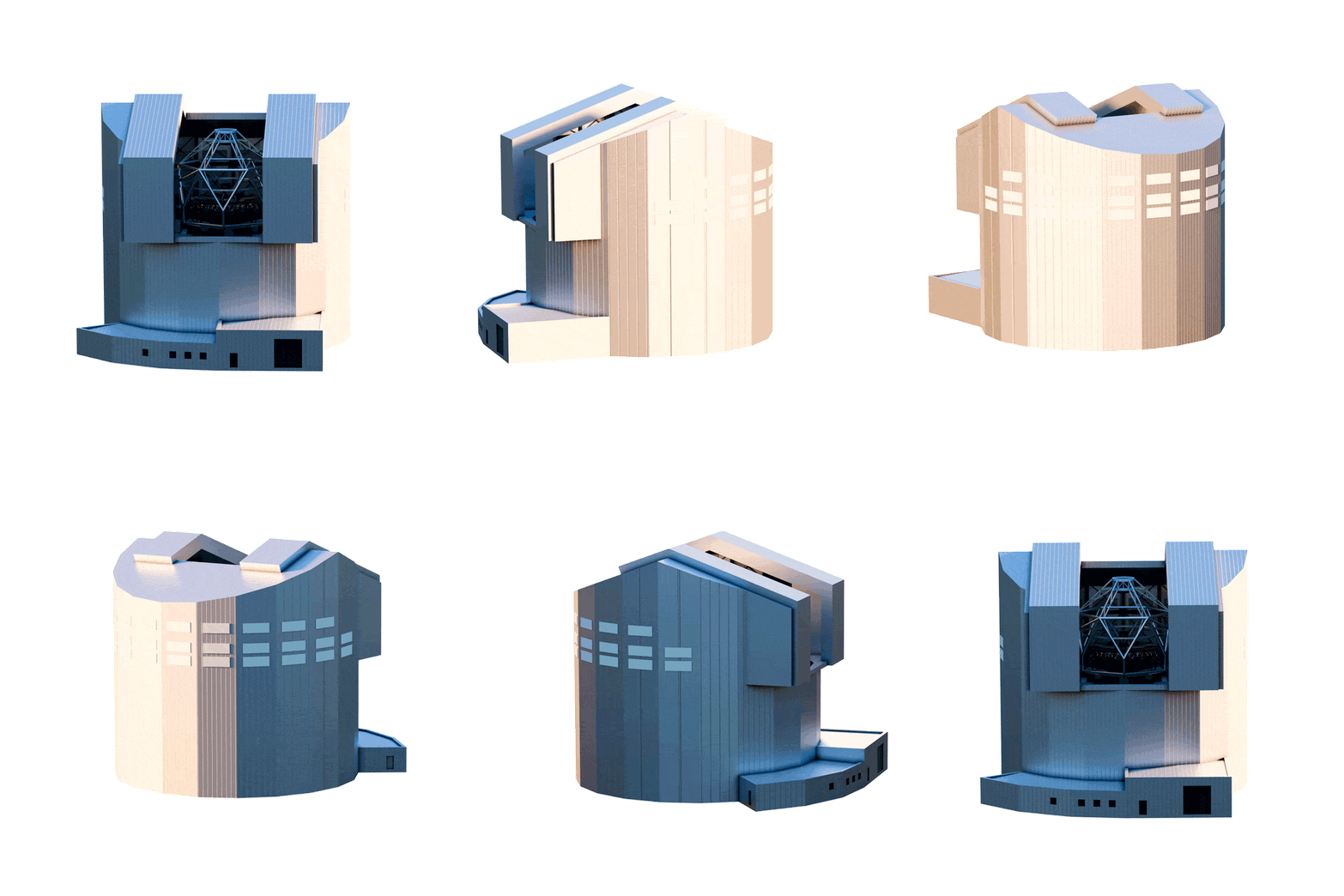
Two-in-one, an original design combining proven solutions

The design of the WST brings together well-established technologies and carefully targeted innovations, always keeping in mind the sustainability of the project. This balance between maturity and novelty allows the WST to remain both ambitious and realistically implementable, delivering breakthrough science on a contained timeframe.

The design

The WST is a 12-m class, Alt-Az optical telescope providing two simultaneously available foci, 3.1 square degrees and 3×3 arc minutes, respectively, for Multi-Object Spectroscopy (MOS) and Integral Field Spectroscopy (IFS) at visible wavelengths. The IFS field can be selected anywhere within a 13 arc-minute patrol field, concentric with the MOS field of view. This unique, dual capability is provided through an original optical solution, combining a wide-field, corrected fast Cassegrain and a coudé arrangement, transporting the central portion of the field down towards a fixed, gravity-invariant station.

Fibres

The ~32,000 fibres front-end interface between the telescope and the MOS instrumentation is located 1.5 m above the primary mirror; the optically de-rotated focal interface with the fixed 144 IFS spectrographs is in the telescope pier, about 18 m below the altitude axis of the telescope.

Primary mirror

The 100 square meter primary mirror is made of 78 near-hexagonal optical segments, almost identical to segments of ESO’s Extremely Large Telescope (ELT). All telescope optics are within proven dimensions and technologies, including physical and functional characteristics.

Telescope operation and control

The telescope will be controlled in real time on-sky, combining techniques successfully integrated in the Keck and VLT projects towards the end of the 20th century, while relying on the latest industrial and technological developments implemented in the ELT. The WST will be controlled to specification from the MOS focal surface; the subsequent IFS optical path includes the metrology and degrees of freedom necessary to adjust for differential perturbations, with limited crosstalk between the two foci, if any. As an option, the design readily includes an optional upgrade path allowing for seeing reduction – aka Ground-Layer Adaptive Optics or GLAO – at the coudé focus.

Site selection

The WST needs to be placed in an adequate site, with excellent seeing, clear nights, and low light pollution.

Next section

overview of the instrumentation for the WST

The WST provide a unique observing capability, to measure both low and high-resolution spectra of many targets over a wide field of view, using multiple object spectroscopy

Acronyms

TECHNICAL

WST: Wide-field Spectroscopic Telescope

FoV: Field-of-View

IFS: Integral Field Spectrograph

IFU: Integral Field Unit

MOS: Multi-Object Spectrograph

MOS-HR: High-resolution Multi-Object Spectrograph

MOS-LR: Low-resolution Multi-Object Spectrograph

ToO: Targets of Opportunity

INSTITUTES & UNIVERSITIES

AIP: Leibniz Institute for Astrophysics Potsdam

ANU/Astralis: The Australian National University / Astralis

CRAL/CNRS: Centre de Recherche Astrophysique de Lyon / French National Centre for Scientific Research

EPFL: Swiss Federal Institute of Technology in Lausanne

ESO: European Southern Observatory

IA/CAUP: Institute of Astrophysics and Space Sciences / Centre for Astrophysics of the University of Porto

IASF-MI/INAF: Institute for Space Astrophysics and Cosmic Physics of Milan / National Institute for Astrophysics

IP2I/CNRS: Institute of Physics of the Two Infinities of Lyon / French National Centre for Scientific Research

IRFU/CEA: Institute for Research into the Fundamental Laws of the Universe / French Alternative Energies and Atomic Energy Commission

Lagrange/CNRS: Lagrange Laboratory / French National Centre for Scientific Research

LAM/CNRS: Marseille Astrophysics Laboratory / French National Centre for Scientific Research

MAQC/Astralis: Macquarie University / Astralis

NCAC: Nicolaus Copernicus Astronomical Center

OAArcetri/INAF: Arcetri Astrophysical Observatory / National Institute for Astrophysics

OABrera/INAF:Brera Astronomical Observatory / National Institute for Astrophysics

OACapodimonte/INAF: Capodimonte Astronomical Observatory / National Institute for Astrophysics

OASBologna/INAF:Bologna Observatory of Astrophysics and Space Science / National Institute for Astrophysics

UKRI: UK Research and Innovation

UNIBO: University of Bologna

UNIGRO/NOVA: University of Groningen / The Netherlands Research School for Astronomy

UNISYD: The University of Sydney

UNIVIE: University of Vienna

UWA: The University of Western Australia

Edit Template

Join the community

ue-logo-h
This project has received funding from the European Union Horizon Europe Research and Innovation Action under grant agreement no. 101183153 -WST.
Views and opinions expressed are however those of the author(s) only and do not necessarily reflect those of the European Union or European Research Executive Agency (REA). Neither the European Union nor the granting authority can be held responsible for them.

Acronyms

TECHNICAL

WST: Wide-field Spectroscopic Telescope

FoV: Field-of-View

IFS: Integral Field Spectrograph

IFU: Integral Field Unit

MOS: Multi-Object Spectrograph

MOS-HR: High-resolution Multi-Object Spectrograph

MOS-LR: Low-resolution Multi-Object Spectrograph

ToO: Targets of Opportunity

INSTITUTES & UNIVERSITIES

AIP: Leibniz Institute for Astrophysics Potsdam

ANU/Astralis: The Australian National University / Astralis

CRAL/CNRS: Centre de Recherche Astrophysique de Lyon / French National Centre for Scientific Research

EPFL: Swiss Federal Institute of Technology in Lausanne

ESO: European Southern Observatory

IA/CAUP: Institute of Astrophysics and Space Sciences / Centre for Astrophysics of the University of Porto

IASF-MI/INAF: Institute for Space Astrophysics and Cosmic Physics of Milan / National Institute for Astrophysics

IP2I/CNRS: Institute of Physics of the Two Infinities of Lyon / French National Centre for Scientific Research

IRFU/CEA: Institute for Research into the Fundamental Laws of the Universe / French Alternative Energies and Atomic Energy Commission

Lagrange/CNRS: Lagrange Laboratory / French National Centre for Scientific Research

LAM/CNRS: Marseille Astrophysics Laboratory / French National Centre for Scientific Research

MAQC/Astralis: Macquarie University / Astralis

NCAC: Nicolaus Copernicus Astronomical Center

OAArcetri/INAF: Arcetri Astrophysical Observatory / National Institute for Astrophysics

OABrera/INAF:Brera Astronomical Observatory / National Institute for Astrophysics

OACapodimonte/INAF: Capodimonte Astronomical Observatory / National Institute for Astrophysics

OASBologna/INAF:Bologna Observatory of Astrophysics and Space Science / National Institute for Astrophysics

UKRI: UK Research and Innovation

UNIBO: University of Bologna

UNIGRO/NOVA: University of Groningen / The Netherlands Research School for Astronomy

UNISYD: The University of Sydney

UNIVIE: University of Vienna

UWA: The University of Western Australia

Edit Template
ue-logo-h
This project has received funding from the European Union Horizon Europe Research and Innovation Action under grant agreement no. 101183153 -WST.
Views and opinions expressed are however those of the author(s) only and do not necessarily reflect those of the European Union or European Research Executive Agency (REA). Neither the European Union nor the granting authority can be held responsible for them.