
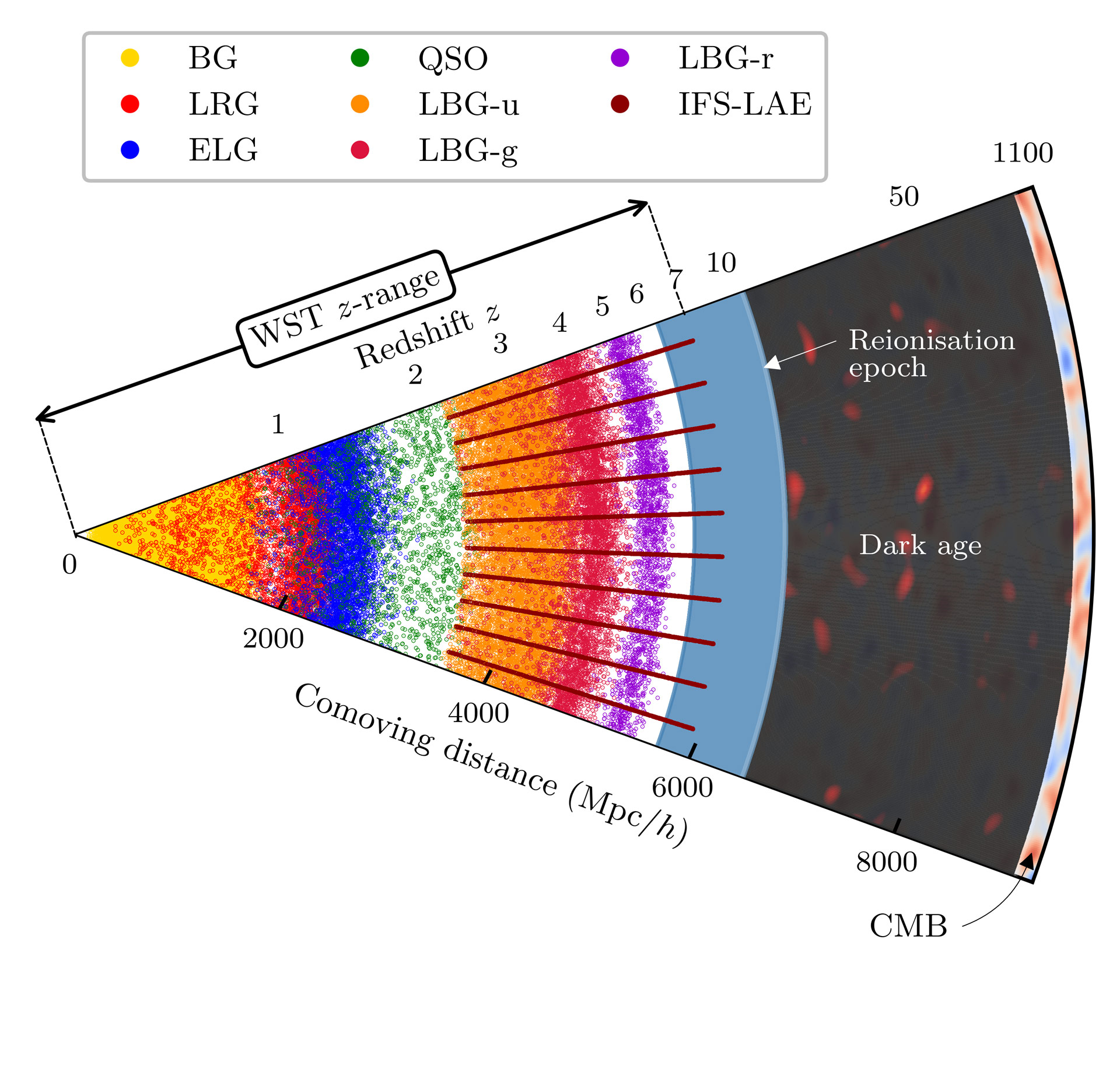

Understanding how dark matter, dark energy, and gravity shape structure across the Universe requires measurements that span from the smallest galaxies to the largest cosmic environments.
The WST will provide this essential multiprobe view, combining local and high-redshift galaxy surveys, cosmic-web mapping, and gravitational-wave counterparts to reveal deviations from standard cosmology.
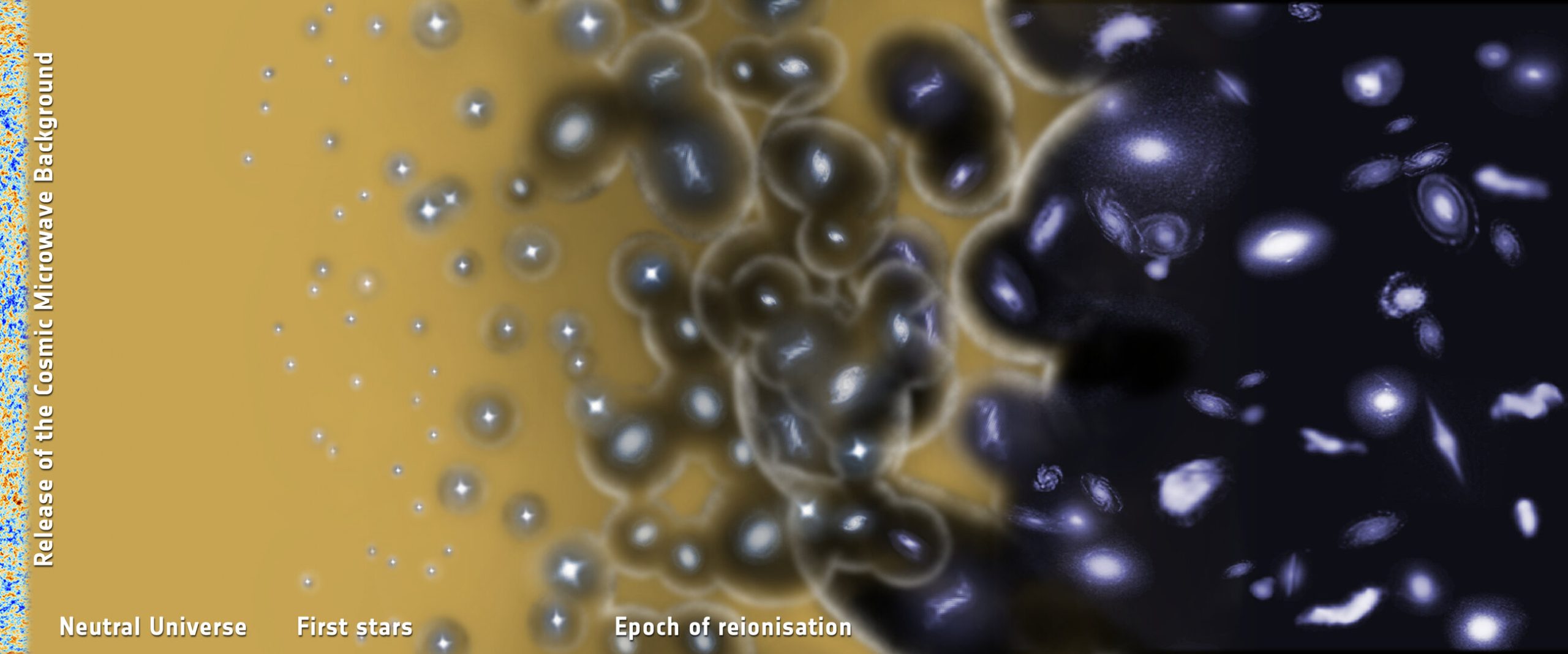
One key phase in the early Universe is the so-called Cosmic reionisation, the period when the gas in intergalactic space transitioned from a neutral to fully ionised state. A popular view is that the process began when star-forming galaxies first bathed the Universe with energetic ultraviolet photons. Studies of the demographics and ionising properties of early galaxies with HST and JWST provide support for this picture, with the earliest galaxies seen at redshifts z~14 when the Universe was less than 300 Myr old. Studies of the Lyman alpha forest seen in absorption to redshift z>6 quasars indicate that neutral patches of the intergalactic medium (IGM) persist down to redshifts z~5.3.
While this observational evidence supports a likely 500 Myr duration of cosmic reionisation from z~14 to z~5.3, the precise role of galaxies and active galactic nuclei (AGN) remains unclear.
Mapping neutral hydrogen in the Universe through the 21-cm hyperfine transition is key to making progress in understanding cosmic reionisation and a major goal of the SKA-Low interferometer. By cross-correlating the fluctuating 21 cm signal with the large-scale distribution of galaxies in the same cosmic volumes it will be possible to directly investigate whether, for example, rare luminous or abundant sub-luminous sources govern the reionisation process.
The WST will be the only telescope that can both chart the distribution of galaxies with the necessary panoramic coverage and sensitivity and characterise the ionising capability of the sample, to enable the statistical cross-correlation analysis between various subsets of the galaxy population and the 21 cm traces of the distribution of neutral gas.
In a hierarchical galaxy formation framework, the inner regions of galaxies are expected to be the oldest. Also in the Milky Way is expected that its oldest stars may peak in the central kpcs. Recent work with homogeneous all-sky Gaia metallicities for millions of stars clearly shows a strong over density of metal-poor stars within the inner ~4-5 kpc of the Milky Way, tracing the proto-Galaxy. To study the infant Milky Way, one should therefore aim to observe and study metal-poor stars in this region. The WST will be able to study with accurate spectral resolution and sensitivity these ancient stars in the inner Galaxy and place constraints on early nucleosynthesis and the formation of the first generations of stars in environments like those being observed at high-redshift.
The WST will fill a critical gap in the global astronomical infrastructure of the 2040s.
Understanding how stars and planets form is fundamental to addressing several open questions of modern astrophysics, yet we do not have a full comprehension of the process.