
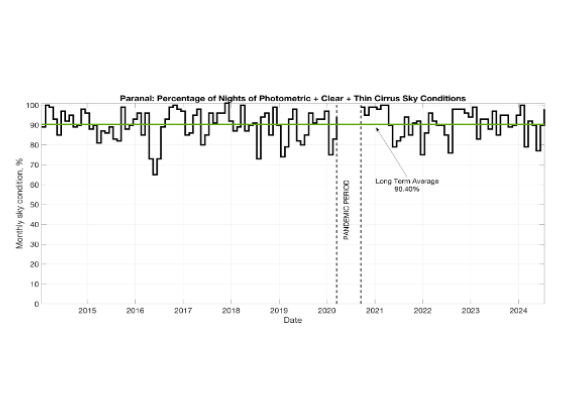
To achieve its scientific requirements and operate at full capacity, the WST needs to be placed in an adequate site, with excellent seeing, clear nights, and low light pollution. Selecting such a site is part of a comprehensive process that involves the investigation and simulation of multiple aspects.
The optimal site for the WST must:

Offer a high fraction of clear nights and long-term atmospheric seeing statistics
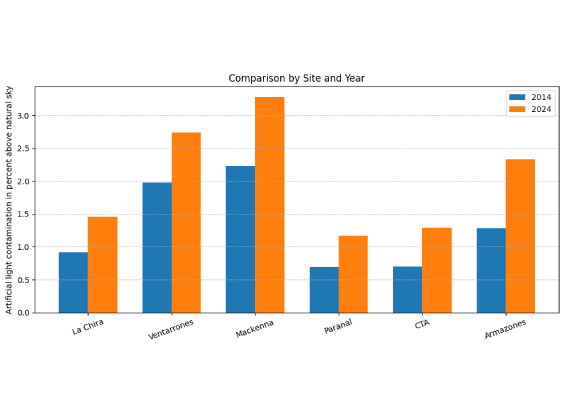
Have very low artificial light pollution and be sufficiently distant from laser-equipped observatories
Based on the criteria listed above and on sustainability considerations, several sites in the area in the vicinity of the ESO’s Paranal and Armazones observatories, in the Region of Antofagasta, northern Chile, have been identified as potential locations: La Chira, La Montura, Ventarrones and Mackena.
The Paranal and Armazones sites offer exceptional observing conditions, with about 90% of usable nights per year (more than 325 nights), and roughly 77% being fully photometric or clear (about 256 nights).
These stable conditions result from the Hadley Cell subsidence of dry air, which warms as it gets compressed towards the surface, and are representative of the whole area near the coastal mountain range.
In terms of atmospheric seeing statistics, for the WST, what matters is the seeing that the telescope/instrument will experience at the height of its primary mirror above ground. Consequently, an important aspect to address in the WST site studies is the vertical profile of turbulence strength as a function of vertical distance.
Seeing measurements from ESO’s Paranal Differential Image Motion Monitor (DIMM) (2016–2025) confirm excellent stability, and comparable statistics have been obtained at nearby candidate peaks. Currently, an atmospheric turbulence profiler and wind speed monitor, installed on a 5-m height tower, is to be deployed at a peak, within the ESO land concession.
At Paranal, the median wind speeds at 30 m above ground range between 5.5 and 7.0 m/s (based on ESO’s long-term statistics), predominantly from the north (330°–30°). Similar conditions are expected at nearby sites, ensuring operational stability for the WST’s large structure.
For a telescope and instruments operating in the visible spectral range a site with negligible (or of very low) artificial light pollution is crucial.
The ESO observatories, La Silla, Paranal, and Armazones sites have been selected since these regions were among the darkest skies worldwide.
Light pollution modelling shows that the La Chira site offers the darkest skies among evaluated candidates (La Chira, Ventarrones, and Mackenna), mainly due to its greater distance from major roads and mining sites. All candidate sites show lower predicted light contamination in 2024+ than existing CTAO and ELT locations.
Given the WST’s focus on the visible spectral range, it is important to consider the potential impact of laser guide stars from neighbouring observatories. Preliminary simulations using the Laser Traffic Control System (LTCS) indicate that the probability of laser light intersecting the WST’s field of view is below 2% per year, and operational coordination tools can further mitigate this.
For relevant links on the atmospheric conditions of the region can be obtained from the ESO Paranal websites, check the box below.
A stand out telescope compared to any existing or planned facility, allowing an extremely broad range of scientific applications
A visit to La Chira
Issue #3 The WST Chronicle