

Within the WST consortium, we recognise that scientific progress must go hand in hand with environmental responsibility. We are therefore exploring ways to make this facility as sustainable as possible.
The ongoing initiatives include:
Assessing the environmental impact of the WST instruments:
The carbon footprint is indeed used as a trade-off parameter to inform the choice of design for the IFS and the two MOS.
After a few decades, the environmental footprint of large-scale infrastructure is typically dominated by operation, particularly energy consumption, due to the need to cool down detectors. Life-cycle assessments of the different design options, in particular for the IFS, are performed, confirming that after ~5 years, the instrument’s operational footprint dominates. CMOS solutions are usually preferred because detectors can work at higher temperatures with respect to CCDs, resulting, for the same design choice, in a ~25% decrease in the total carbon footprint.
Investigating different ways to deal with the very high amount of data expected:
We have also entered an era of “big data”, driven by advances in Artificial Intelligence and high-performance computing. The use of energy and water for cooling the data centres is considerable. The WST is expected to generate very large volumes of data, estimated between 1 and 3 PetaByte per year. We are therefore investigating ways to store and manage this data in the most environmentally responsible way possible.
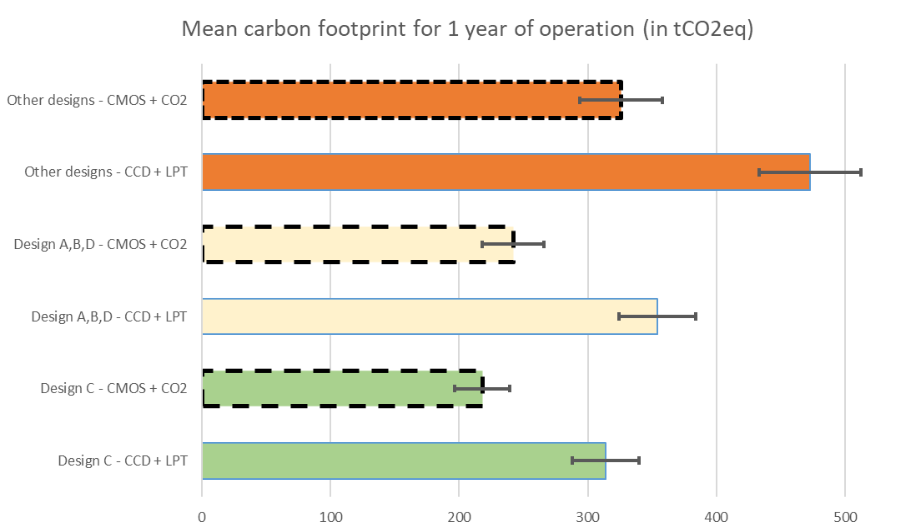
Lead of the carbon footprint analysis. The plot shows the mean carbon footprint for 1 year of operation of the Integral field Unit in tons of CO2 eq. for different design choices. The carbon footprint associated with designs using CMOS detectors and CO2 plus Peltier cooling system is plotted in dark dashed line while the carbon footprint associated with designs using CCDs and Linear Pulse Tube cryocoolers are plotted with a light blue contour. Designs A,B, and D (light yellow) all have 144 spectrographs. Design C (green) consists of 128 spectrographs. Designs labelled as “Other” have 192 spectrographs. The error bars associated with the carbon footprint are visible.
Credits: Laurane FréourEncouraging discussions inside the working group on sustainability:
These challenges are being addressed through a dedicated working group, supported by the project office, with close collaboration between the sustainability working group and the Equity, Diversity and Inclusion (EDI) group to ensure that environmental responsibility and inclusivity advance together within the community. Beyond institutional efforts, astronomy contributes to broader societal well-being, which is considered one of the pillars of sustainability in a broader sense. In this regard, it can support mental health by fostering awe and a sense of belonging, promote gender equality through initiatives such as girls’ astronomy camps that encourage young women to pursue STEM careers, and support peace-building by bringing communities together in regions affected by conflict.

Interview with Laurane Freour
Issue #2 The WST Chronicle"Sustainability should be taken into account as early as possible"