
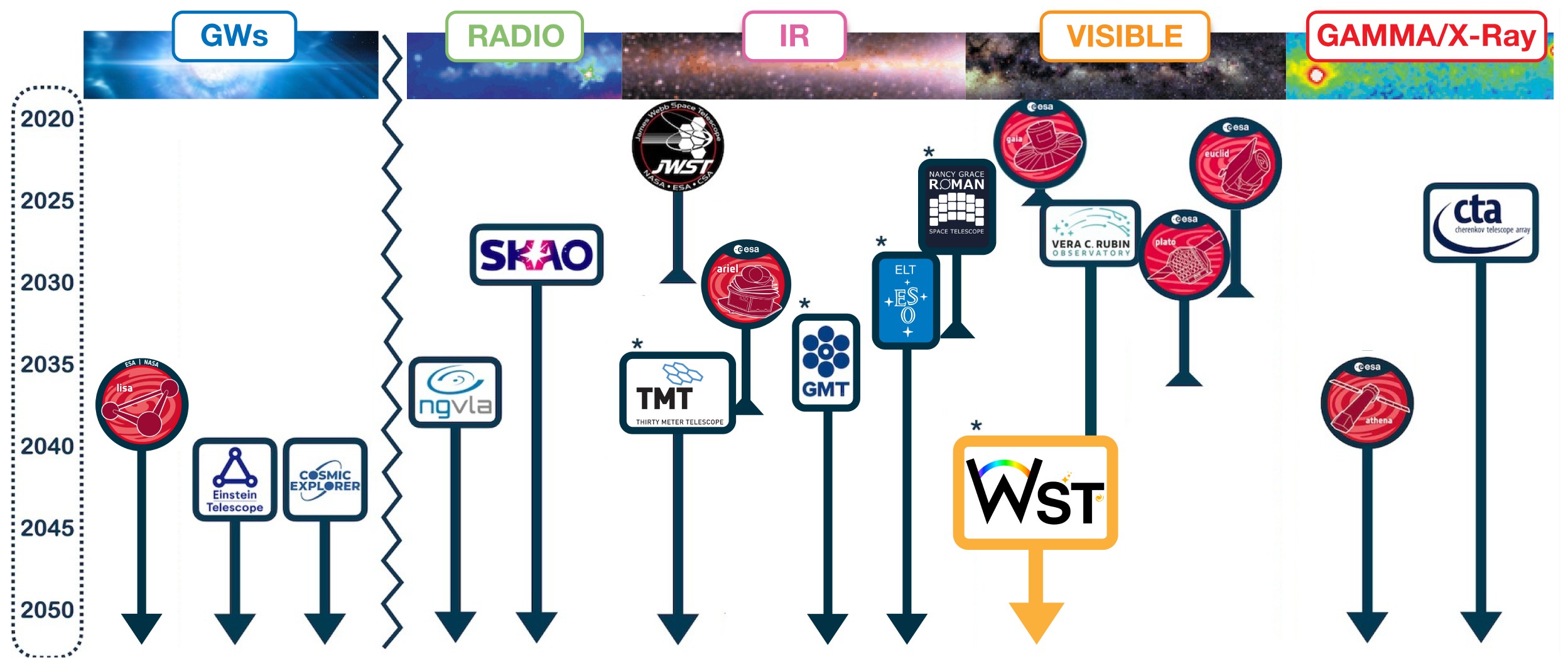
The WST will fill a critical gap in the global astronomical infrastructure of the 2040s.
By delivering unprecedented spectroscopic mapping of the Universe, the WST will fundamentally reshape the scientific landscape and unlock entirely new discovery space for both current and future ground- and space-based observatories. Its surveys will not only maximise the scientific return of major facilities such as the ELT, Rubin/LSST, Gaia, Euclid, Roman, SKAO, and gravitational wave interferometers, but will also enable science that is simply inaccessible without the WST.
A few examples are described below.
The Gaia MISSION
The ESA Gaia mission has been a gamechanger for our comprehension of the assembly and accretion history of the Milky Way, providing positions, distances, motions, and photometry of nearly two billion stars with unprecedented precision. The final Gaia data release is expected by the start of the next decade; however, even in the 2040s a major fraction of the stars with exquisite astrometry from Gaia will still miss the fundamental spectroscopic information providing detailed elemental abundances and radial velocities. For the brighter stars, the combination of R=40,000, high-multiplex and large collecting area make WST uniquely positioned to combine the precise chemistry and kinematics of the stellar populations in the Milky Way; for the fainter ones, at larger distances, the low resolution multi-object spectrograph (MOS) will still allow radial velocities and metallicities to be measured for tens of millions of stars, enabling a detailed reconstruction of formation history of our Galaxy and its components.
Radio, High-Energy, Gravitational Waves and Particle Messengers
Multi-messenger astronomy will be mainstream in the WST era, and entire facilities will be dedicated to rapidly evolving phenomena, spanning energy ranges from TeV (CTA) through μeV (SKAO). Next-generation gravitational wave observatories such as the Einstein Telescope, Cosmic Explorer, and the ESA’s LISA mission, along with astro-particle detectors like IceCube or Antares, will deliver real time, full-sky multi-messenger alerts. The unique combination of field of view, sensitivity, and multiplexing of the WST will be crucial to detect and characterise the electromagnetic counterparts of such events.
The WST will have remarkable synergies with radio facilities that will be fully operational in the 2040s, such as SKAO and ngVLA. The MOS of the WST will be uniquely placed to understand the spectral properties and redshift distribution of the new population of sources that will be discovered with at radio wavelengths, therefore providing valuable information about large-scale structure formation, galaxy evolution, and the origin of the large-scale coherent magnetic fields in galaxies over cosmic time.
Future X-ray missions, such as NewAthena, will characterise the hot circum-galactic medium surrounding galaxies in a wide redshift range. The IFS of the WST will be uniquely suited to complement the mapping of the ionised gas on similar scales, therefore providing the panoramic multi-phase view of the gas that is a key element to understand how baryons flow in and out galaxies, the so-called baryon cycle.
References
Bisero et al. 2026, A&A 705, 54 –> Bisero et al. 2026, Multi-messenger observations of binary neutron star mergers: Synergies between next-generation gravitational wave interferometers and wide-field, high-multiplex spectroscopic facilities, A&A 705, 54, DOI:10.1051/0004-6361/202556217
A graphical representation of the current and upcoming major astronomical facilities. The facility marked with an asterisk (e.g., ELT, TMT, GMT) have been listed in the spectral range they cover the most for visual purposes, but they also partly cover other bands. The duration of space missions reflects the publicly available nominal values.
WST will have strong synergies with many of those, filling in a gap in the current landscape. Credits: Camilla Danielski. Background images: ESO/L. Calçada/M. Kornmesser; NASA Godard SFC.

Next section
How do supermassive black holes form, and what is the black hole mass function? WST’s statistical power will constrain the full black hole population, intermediate-mass black holes and their impact on galaxies.
We use cookies that are essential for accessing our websites and using our services. We also use cookies to analyse, measure and improve our websites’ performance, to enable content sharing via social media and to display media content hosted on third-party platforms.
You can manage your cookie preferences and find out more by visiting 'Cookie Settings and Policy'.
The WST' Scientific Synergies
Issue #3 The WST Chronicle