
Many objects in the Universe are moving, flaring, and transforming — and every change tells a story. Time-variable phenomena can occur on any physical scale, from the Solar System to distant galaxies, and on very different timescales, mainly between hours and years.
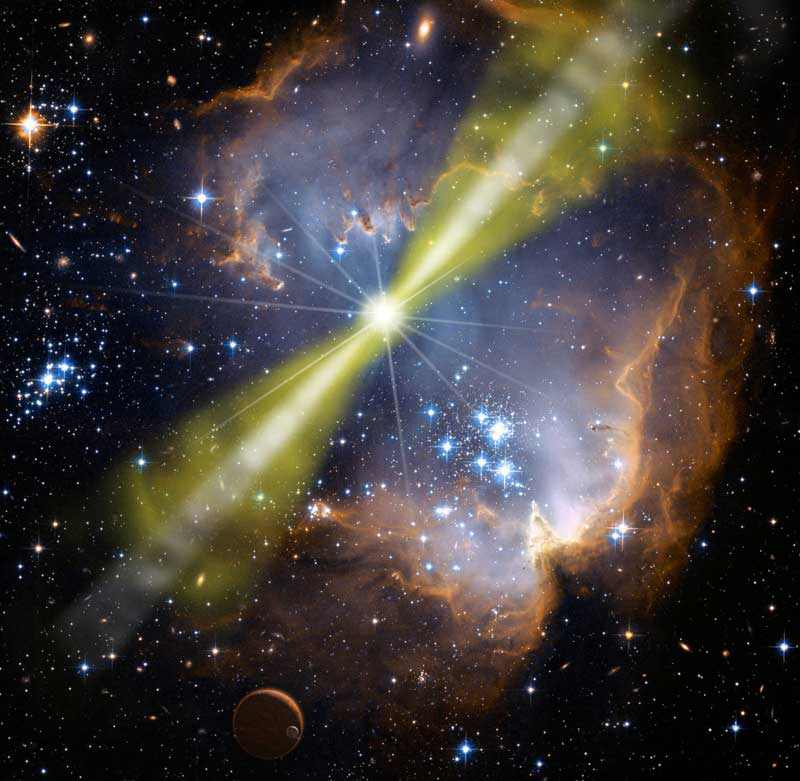
Some variations unfold slowly, like the steady pulse of variable stars, while others erupt in spectacular fashion as supernovae or gamma-ray bursts (GRBs). Exploring this ever-changing sky is key to addressing a large variety of science questions.
The WST will provide an unmatched combination of spectroscopic and time-domain capabilities, including both repeated and target-of-opportunity observations (ToO), that will allow such an exploration for unprecedented numbers of different types of faint sources, combining statistical power with detailed spectroscopic information.
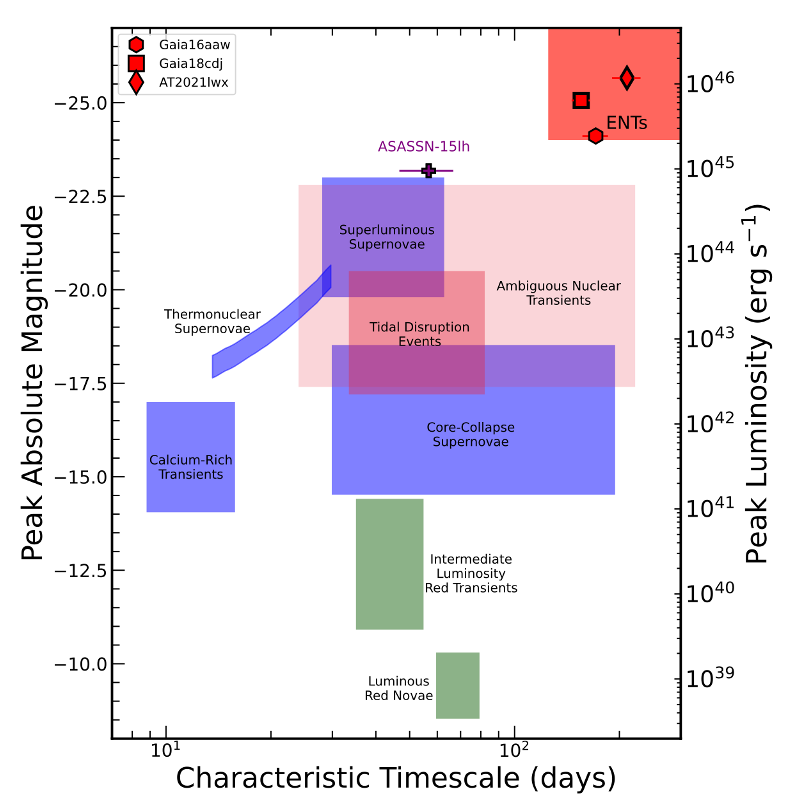
The WST’s IFS and MOS low resolution will collect low-resolution spectra of thousands of transient phenomena every night, including, among others: active galactic nuclei and nuclear transients, that will allow constraining the black hole mass function; tidal disruption events and GRBs: the WST indeed presents an exceptional opportunity to explore deeper into the nature of GRBs by leveraging some fibres across its wide field.
Early observations after the trigger will facilitate investigations into GRB prompt emissions and initial conditions of the explosion. Also, by conducting spectroscopic observations of GRB afterglows, the WST can dissect the signatures imprinted on their spectra and investigate the intergalactic medium properties, also tracing the cosmic web; the host galaxy environment, and the progenitor properties; supernovae (SNe): the WST will have enormous statistical potential for discovering and characterizing novel SNe types.
This will provide unique and crucial insights into the extreme physics of the explosion mechanisms and possibly lead to the detection, for the first time, of luminous and long-lived pair-instability supernovae that have been predicted to originate from massive (140 – 260 Msun) metal-poor stars.
The WST will allow achieving an unprecedented picture of the small body population, composition and dynamics in planetary systems, including Solar System comets, asteroids and TNOs, as well as exocomets; it will capture the diverse variability of young stellar objects (YSOs); thanks to repeated observations, it will enable a revolution in the study of pulsating stars, securing detailed pulsation phases and chemical compositions. This will provide critical insights into stellar evolution, binary interactions, and the calibration of cosmic distance indicators. The large, statistically significant sample will also improve our understanding of Galactic structure and formation processes.
The IFS will be crucial to provide a holistic view of the binary populations inside massive star clusters; the MOS will permit time resolved spectroscopy and a comprehensive monitoring of the radial velocity and variability of a few hundred thousand different types of white dwarfs (WDs), including polluted ones, WDs in binary systems, detached binary WDs, with implications for planet formation, stellar evolution, gravitational waves.
The WST will fill a critical gap in the global astronomical infrastructure of the 2040s.