New frontiers of spectroscopic surveys

Learn about the capabilities of the WST, the requirements on each instrument, how it compares with other facilities and how it will adapt to new technologies and needs.

Top-level requirements

From science goals to system requirements

TABLE HEADER 1
TABLE HEADER 2
TELESCOPE
Telescope Aperture
12 m
Telescope FoV
3.1 sq. deg
Telescope Spec Range
0.35-1.6 µm
MOS & IFS parallel operations
ToO implemented at telescope and fibre level
INSTRUMENTS
MOS LR Multiplex
30,000
MOS LR Resolving Power
> 3,000
MOS LR Spec Range
370-930 nm (simultaneous)
MOS HR Multiplex
2.000
MOS HR Resolving Power
40,000
MOS HR Spec Range
370-930 nm (4 regions)
IFS FoV
3 x3 sq. arcmin
IFS Resolving Power
>3,000
IFS Spec Range
370-930 nm (simultaneous)
IFS Patrol Field
13 arcmin diameter
TABLE HEADER 1
TABLE HEADER 2
TELESCOPE
Telescope Aperture
12 m
Telescope FoV
3.1 sq. deg
Telescope Spec Range
0.37-1.6 µm
MOS & IFS parallel operations
ToO implemented at telescope and fibre level
TABLE HEADER 1
TABLE HEADER 2
INSTRUMENTS
MOS LR Multiplex
30,000
MOS LR Resolving Power
> 3,000
MOS LR Spec Range
370-930 nm (simultaneous)
MOS HR Multiplex
2.000
MOS HR Resolving Power
40,000
MOS HR Spec Range
370-930 nm (4 regions)
IFS FoV
3 x3 sq. arcmin
IFS Resolving Power
> 3,000
IFS Spec Range
370-930 nm (simultaneous)
IFS Patrol Field
13 arcmin diameter

Note: FoV = Field of View, ToO = Targets of Opportunity, MOS = multi-object spectrograph, IFS = integral field spectrograph
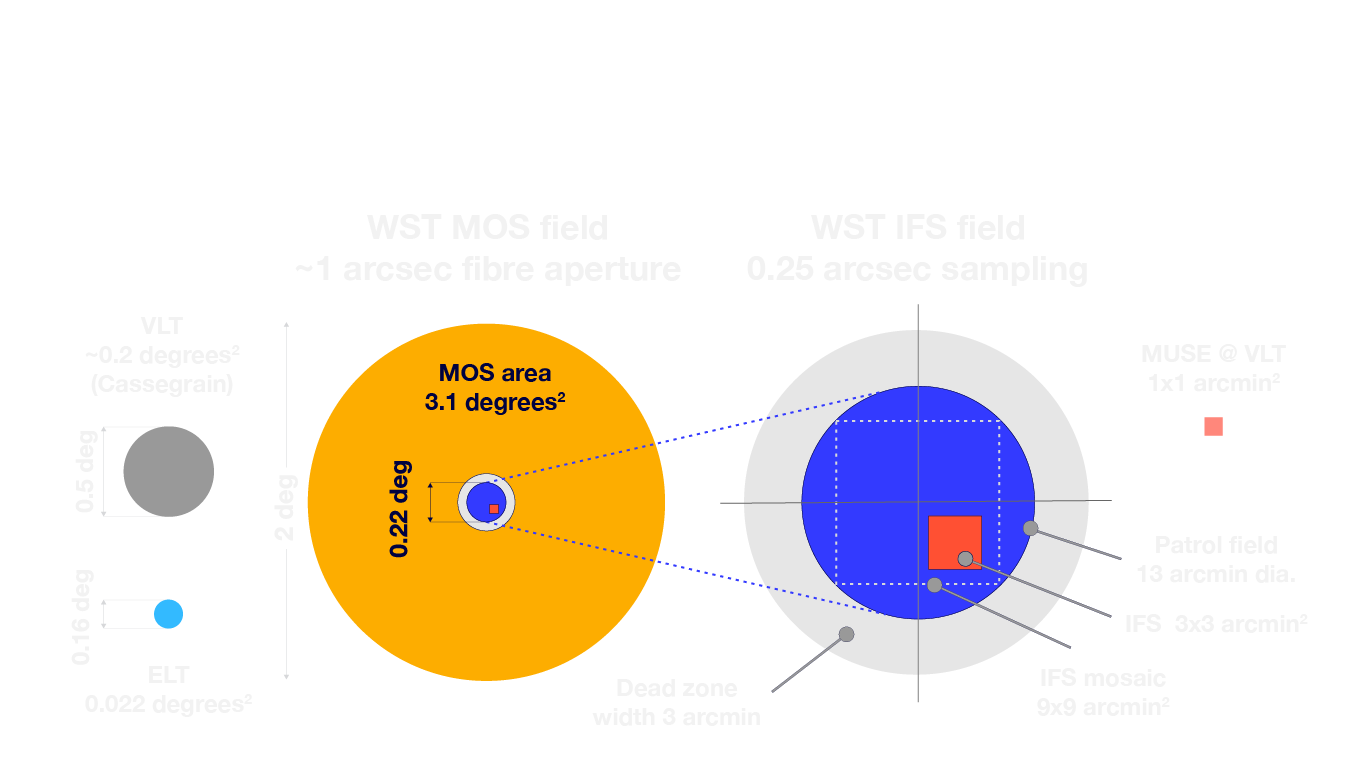
Caption: The WST FoV. The left panel shows the MOS FoV and the central circular area available for IFS observations. The right panel offers a closer view of the latter. The IFS 3x3 arcmin2 FoV (in red) can be moved within the available area, providing the 9x9 arcmin2 mosaic capability. The VLT, ELT and MUSE FoV are represented for comparison. Credits: The WST consortium

How does the WST compare to other facilities?

These ambitious requirements will place the WST MOS and IFS capabilities far ahead of the existing or planned competing facilities. Using the collecting area and the fibre multiplex gain as a measure of the survey speed, WST MOS will be [Bryson, I1] faster by x27 than PFS@Subaru, by x22 than MOONS@VLT, and by x6 than MUST. The WST IFS, with its large field of view, good spatial resolution, and large simultaneous example, using the etendue metric, it will be 19 and 16 times faster than the European MUSE@VLT and the US KCWI@Keck, respectively.
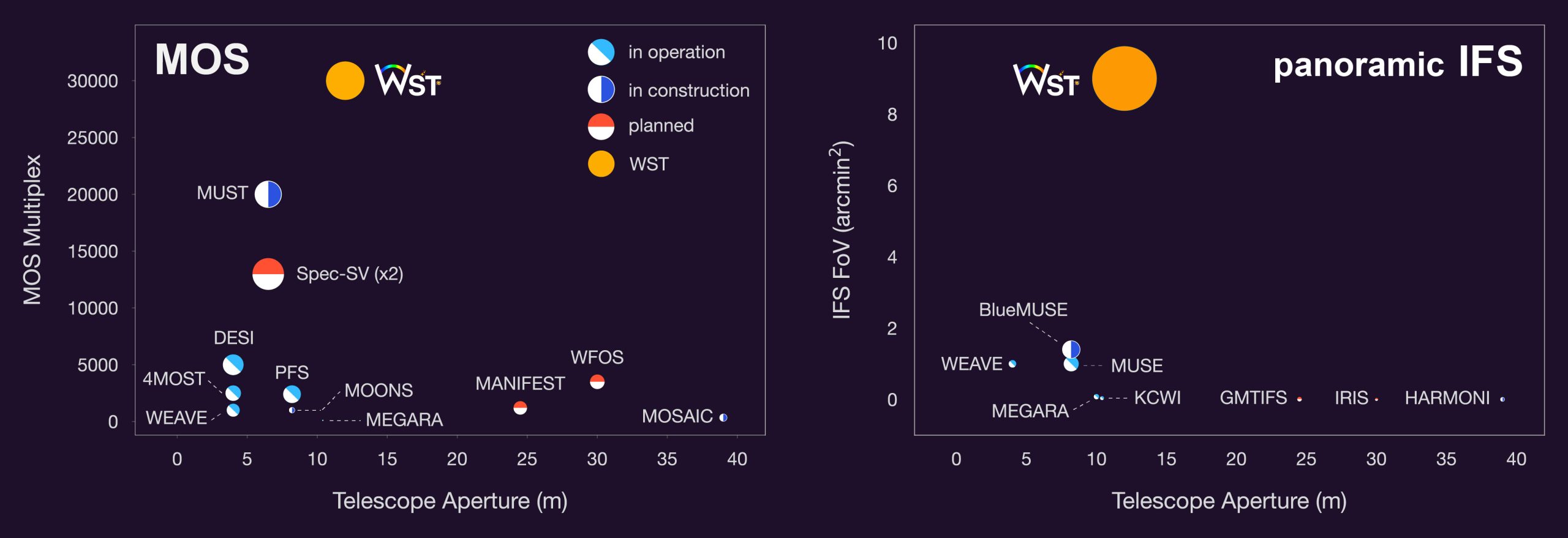
Comparison of WST MOS and IFS capabilities with existing and proposed ground-based spectroscopic facilities. Circle areas are proportional to the etendue (i.e., aperture times field of view area). For clarity, MOS or IFS with small multiplex or field of view are not shown in these figures. Multi-IFUs (e.g. KMOS, Hector or MaNGA) or sparse-field panoramic IFS (e.g. HETDEX) are not shown in this comparison, which only considers panoramic (monolithic) IFS with 100% fill-factor. However, multi-IFUs are considered as a possible WST upgrade to the MOS components.

However, not only will the WST perform significantly better than any existing or planned MOS or IFS instruments, but the parallel operation of its MOS and IFS capabilities as a single facility will represent a significant advance in the overall scientific capability available to astrophysicists and cosmologists. Its built-in time-domain capabilities will position WST as a cornerstone of multi-messenger science in the 2040s.

Looking ahead: an adaptive strategy for an evolving framework

As with previous ESO flagship telescopes such as the VLT and ELT, the WST is expected to have an operational lifetime exceeding 50 years. To ensure the facility remains at the forefront of scientific discovery over such a long timescale, a strategy for long-term evolution and upgradeability is being developed. This will allow WST to adapt to evolving scientific priorities and to take advantage of emerging technologies.

Several upgrade paths have already been identified, including:

  • An infrared extension of the MOS-LR, and
  • Deployment of mini-IFUs within the MOS

Next section

TWO-in-one

an original design combining proven solutions

Acronyms

TECHNICAL

WST: Wide-field Spectroscopic Telescope

FoV: Field-of-View

IFS: Integral Field Spectrograph

IFU: Integral Field Unit

MOS: Multi-Object Spectrograph

MOS-HR: High-resolution Multi-Object Spectrograph

MOS-LR: Low-resolution Multi-Object Spectrograph

ToO: Targets of Opportunity

INSTITUTES & UNIVERSITIES

AIP: Leibniz Institute for Astrophysics Potsdam

ANU/Astralis: The Australian National University / Astralis

CRAL/CNRS: Centre de Recherche Astrophysique de Lyon / French National Centre for Scientific Research

EPFL: Swiss Federal Institute of Technology in Lausanne

ESO: European Southern Observatory

IA/CAUP: Institute of Astrophysics and Space Sciences / Centre for Astrophysics of the University of Porto

IASF-MI/INAF: Institute for Space Astrophysics and Cosmic Physics of Milan / National Institute for Astrophysics

IP2I/CNRS: Institute of Physics of the Two Infinities of Lyon / French National Centre for Scientific Research

IRFU/CEA: Institute for Research into the Fundamental Laws of the Universe / French Alternative Energies and Atomic Energy Commission

Lagrange/CNRS: Lagrange Laboratory / French National Centre for Scientific Research

LAM/CNRS: Marseille Astrophysics Laboratory / French National Centre for Scientific Research

MAQC/Astralis: Macquarie University / Astralis

NCAC: Nicolaus Copernicus Astronomical Center

OAArcetri/INAF: Arcetri Astrophysical Observatory / National Institute for Astrophysics

OABrera/INAF:Brera Astronomical Observatory / National Institute for Astrophysics

OACapodimonte/INAF: Capodimonte Astronomical Observatory / National Institute for Astrophysics

OASBologna/INAF:Bologna Observatory of Astrophysics and Space Science / National Institute for Astrophysics

UKRI: UK Research and Innovation

UNIBO: University of Bologna

UNIGRO/NOVA: University of Groningen / The Netherlands Research School for Astronomy

UNISYD: The University of Sydney

UNIVIE: University of Vienna

UWA: The University of Western Australia

Edit Template

Join the community

ue-logo-h
This project has received funding from the European Union Horizon Europe Research and Innovation Action under grant agreement no. 101183153 -WST.
Views and opinions expressed are however those of the author(s) only and do not necessarily reflect those of the European Union or European Research Executive Agency (REA). Neither the European Union nor the granting authority can be held responsible for them.

Acronyms

TECHNICAL

WST: Wide-field Spectroscopic Telescope

FoV: Field-of-View

IFS: Integral Field Spectrograph

IFU: Integral Field Unit

MOS: Multi-Object Spectrograph

MOS-HR: High-resolution Multi-Object Spectrograph

MOS-LR: Low-resolution Multi-Object Spectrograph

ToO: Targets of Opportunity

INSTITUTES & UNIVERSITIES

AIP: Leibniz Institute for Astrophysics Potsdam

ANU/Astralis: The Australian National University / Astralis

CRAL/CNRS: Centre de Recherche Astrophysique de Lyon / French National Centre for Scientific Research

EPFL: Swiss Federal Institute of Technology in Lausanne

ESO: European Southern Observatory

IA/CAUP: Institute of Astrophysics and Space Sciences / Centre for Astrophysics of the University of Porto

IASF-MI/INAF: Institute for Space Astrophysics and Cosmic Physics of Milan / National Institute for Astrophysics

IP2I/CNRS: Institute of Physics of the Two Infinities of Lyon / French National Centre for Scientific Research

IRFU/CEA: Institute for Research into the Fundamental Laws of the Universe / French Alternative Energies and Atomic Energy Commission

Lagrange/CNRS: Lagrange Laboratory / French National Centre for Scientific Research

LAM/CNRS: Marseille Astrophysics Laboratory / French National Centre for Scientific Research

MAQC/Astralis: Macquarie University / Astralis

NCAC: Nicolaus Copernicus Astronomical Center

OAArcetri/INAF: Arcetri Astrophysical Observatory / National Institute for Astrophysics

OABrera/INAF:Brera Astronomical Observatory / National Institute for Astrophysics

OACapodimonte/INAF: Capodimonte Astronomical Observatory / National Institute for Astrophysics

OASBologna/INAF:Bologna Observatory of Astrophysics and Space Science / National Institute for Astrophysics

UKRI: UK Research and Innovation

UNIBO: University of Bologna

UNIGRO/NOVA: University of Groningen / The Netherlands Research School for Astronomy

UNISYD: The University of Sydney

UNIVIE: University of Vienna

UWA: The University of Western Australia

Edit Template
ue-logo-h
This project has received funding from the European Union Horizon Europe Research and Innovation Action under grant agreement no. 101183153 -WST.
Views and opinions expressed are however those of the author(s) only and do not necessarily reflect those of the European Union or European Research Executive Agency (REA). Neither the European Union nor the granting authority can be held responsible for them.