Research institutes & Universities
0
Work packages
0
Countries involved
0

The Horizon Consortium brings together all the expertise required to perform the concept study of a facility as ambitious as the WST.

This includes all the different aspects involved in such a process, from defining the science goals and requirements, to designing the telescope and the instruments, to planning its operations and data management, to ensuring the sustainability of the project.

Consortium members

Many institutions, one horizon

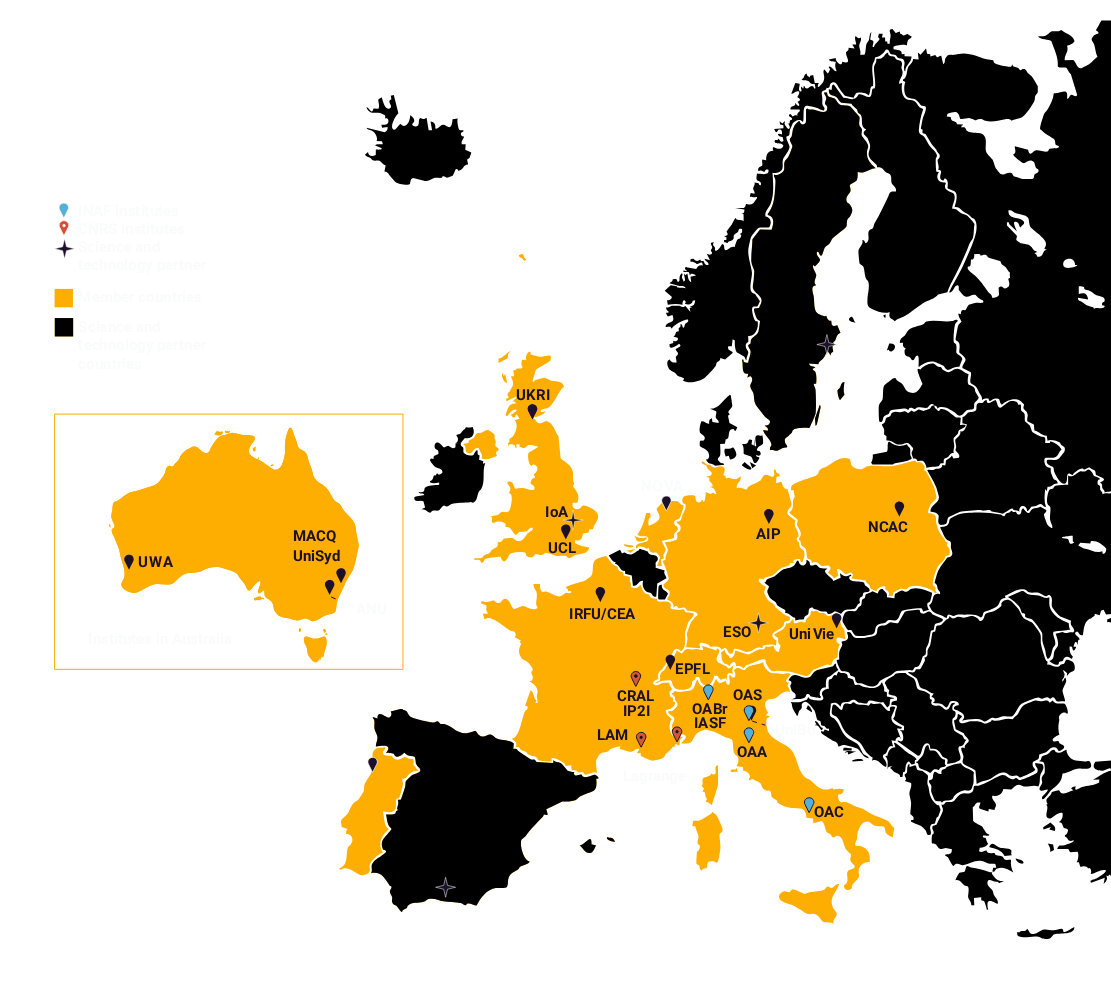
The Horizon Consortium brings together 23 research institutes and universities, including three institutes of the Centre National de la Recherche Scientifique (CNRS) in France and five institutes of the Istituto Nazionale di Astrofisica (INAF) in Italy. It also includes the European Southern Observatory (ESO), which participates as an intergovernmental partner. In addition, three science and technology institutes are part of the broader consortium but not of the Horizon Consortium itself.

In addition to having significant experience in leading and running spectroscopic surveys, the whole consortium has an impressive record in instrumentation and telescope projects. Collectively, its members have built or are currently involved in the design and construction of nine optical telescopes, eight multi-object spectrographs (MOS), and ten integral-field spectrographs (IFS).

members

CRAL/CNRS

Lyon, France

IP2I/CNRS

Lyon, France

Lagrange/CNRS

Nice, France

LAM/CNRS

Marseille, France

IRFU/CEA

Paris, France

OAArcetri/INAF

Florence, Italy

OABrera/INAF

Milano, Italy

OASBologna/INAF

Bologna, Italy

IASF-MI/INAF

Milano, Italy

OACapodimonte/INAF

Napoli, Italy

UNIBO

Bologna, Italy

NCAC

Warsaw, Poland

IA/CAUP

Porto, Portugal

UNIGRO/NOVA

Groningen, The Netherlands

UCL

London, UK

UKRI

Edinburgh, UK

UNIVIE

Wien, Austria

AIP

Potsdam, Germany

EPFL

Lausanne, Switzerland

ANU/Astralis

Canberra, Australia

MAQC/Astralis

Sydney, Australia

UNISYD

Sydney, Australia

UWA

Perth, Australia

Stockholm University

Stockholm, Sweden

Instituto de Astrofísica de Andalucía

Grenada, Spain

Institute of Astronomy Cambridge

Cambridge, UK

ESO

Science and technology partner
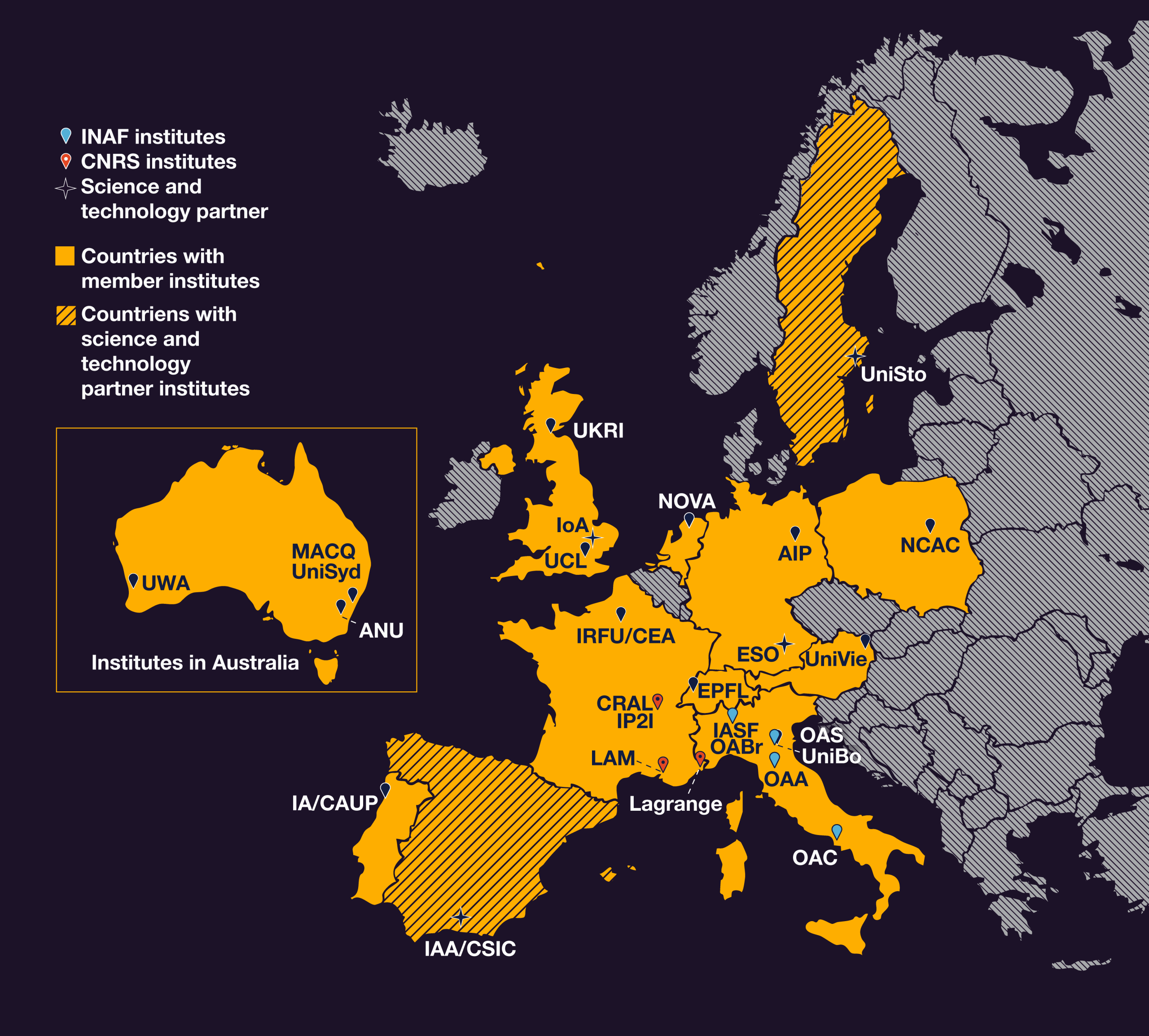
members

CRAL/CNRS

Lyon, France

IP2I/CNRS

Lyon, France

Lagrange/CNRS

Nice, France

LAM/CNRS

Marseille, France

IRFU/CEA

Paris, France

IRFU/CEA

Paris, France

OAArcetri/INAF

Florence, Italy

OABrera/INAF

Milano, Italy

OASBologna/INAF

Bologna, Italy

IASF-MI/INAF

Milano, Italy

OACapodimonte/INAF

Napoli, Italy

UNIBO

Bologna, Italy

NCAC

Warsaw, Poland

IA/CAUP

Porto, Portugal

UNIGRO/NOVA

Groningen, The Netherlands

UCL

London, UK

UKRI

Edinburgh, UK

UNIVIE

Wien, Austria

AIP

Potsdam, Germany

EPFL

Lousanne, Switzerland

ANU/Astralis

Canberra, Australia

MAQC/Astralis

Sydney, Australia

UNISYD

Sydney, Australia

UWA

Perth, Australia

Stockholm University

Stockholm, Sweden

Instituto de Astrofísica de Andalucía

Grenada, Spain

Institute of Astronomy Cambridge

Cambridge, UK

ESO

Science and technology partner

Next section

Steering committee

Members of the WST Steering Committee

Acronyms

TECHNICAL

WST: Wide-field Spectroscopic Telescope

FoV: Field-of-View

IFS: Integral Field Spectrograph

IFU: Integral Field Unit

MOS: Multi-Object Spectrograph

MOS-HR: High-resolution Multi-Object Spectrograph

MOS-LR: Low-resolution Multi-Object Spectrograph

ToO: Targets of Opportunity

INSTITUTES & UNIVERSITIES

AIP: Leibniz Institute for Astrophysics Potsdam

ANU/Astralis: The Australian National University / Astralis

CRAL/CNRS: Centre de Recherche Astrophysique de Lyon / French National Centre for Scientific Research

EPFL: Swiss Federal Institute of Technology in Lausanne

ESO: European Southern Observatory

IA/CAUP: Institute of Astrophysics and Space Sciences / Centre for Astrophysics of the University of Porto

IASF-MI/INAF: Institute for Space Astrophysics and Cosmic Physics of Milan / National Institute for Astrophysics

IP2I/CNRS: Institute of Physics of the Two Infinities of Lyon / French National Centre for Scientific Research

IRFU/CEA: Institute for Research into the Fundamental Laws of the Universe / French Alternative Energies and Atomic Energy Commission

Lagrange/CNRS: Lagrange Laboratory / French National Centre for Scientific Research

LAM/CNRS: Marseille Astrophysics Laboratory / French National Centre for Scientific Research

MAQC/Astralis: Macquarie University / Astralis

NCAC: Nicolaus Copernicus Astronomical Center

OAArcetri/INAF: Arcetri Astrophysical Observatory / National Institute for Astrophysics

OABrera/INAF:Brera Astronomical Observatory / National Institute for Astrophysics

OACapodimonte/INAF: Capodimonte Astronomical Observatory / National Institute for Astrophysics

OASBologna/INAF:Bologna Observatory of Astrophysics and Space Science / National Institute for Astrophysics

UKRI: UK Research and Innovation

UNIBO: University of Bologna

UNIGRO/NOVA: University of Groningen / The Netherlands Research School for Astronomy

UNISYD: The University of Sydney

UNIVIE: University of Vienna

UWA: The University of Western Australia

Edit Template

Join the community

ue-logo-h
This project has received funding from the European Union Horizon Europe Research and Innovation Action under grant agreement no. 101183153 -WST.
Views and opinions expressed are however those of the author(s) only and do not necessarily reflect those of the European Union or European Research Executive Agency (REA). Neither the European Union nor the granting authority can be held responsible for them.

Acronyms

TECHNICAL

WST: Wide-field Spectroscopic Telescope

FoV: Field-of-View

IFS: Integral Field Spectrograph

IFU: Integral Field Unit

MOS: Multi-Object Spectrograph

MOS-HR: High-resolution Multi-Object Spectrograph

MOS-LR: Low-resolution Multi-Object Spectrograph

ToO: Targets of Opportunity

INSTITUTES & UNIVERSITIES

AIP: Leibniz Institute for Astrophysics Potsdam

ANU/Astralis: The Australian National University / Astralis

CRAL/CNRS: Centre de Recherche Astrophysique de Lyon / French National Centre for Scientific Research

EPFL: Swiss Federal Institute of Technology in Lausanne

ESO: European Southern Observatory

IA/CAUP: Institute of Astrophysics and Space Sciences / Centre for Astrophysics of the University of Porto

IASF-MI/INAF: Institute for Space Astrophysics and Cosmic Physics of Milan / National Institute for Astrophysics

IP2I/CNRS: Institute of Physics of the Two Infinities of Lyon / French National Centre for Scientific Research

IRFU/CEA: Institute for Research into the Fundamental Laws of the Universe / French Alternative Energies and Atomic Energy Commission

Lagrange/CNRS: Lagrange Laboratory / French National Centre for Scientific Research

LAM/CNRS: Marseille Astrophysics Laboratory / French National Centre for Scientific Research

MAQC/Astralis: Macquarie University / Astralis

NCAC: Nicolaus Copernicus Astronomical Center

OAArcetri/INAF: Arcetri Astrophysical Observatory / National Institute for Astrophysics

OABrera/INAF:Brera Astronomical Observatory / National Institute for Astrophysics

OACapodimonte/INAF: Capodimonte Astronomical Observatory / National Institute for Astrophysics

OASBologna/INAF:Bologna Observatory of Astrophysics and Space Science / National Institute for Astrophysics

UKRI: UK Research and Innovation

UNIBO: University of Bologna

UNIGRO/NOVA: University of Groningen / The Netherlands Research School for Astronomy

UNISYD: The University of Sydney

UNIVIE: University of Vienna

UWA: The University of Western Australia

Edit Template
ue-logo-h
This project has received funding from the European Union Horizon Europe Research and Innovation Action under grant agreement no. 101183153 -WST.
Views and opinions expressed are however those of the author(s) only and do not necessarily reflect those of the European Union or European Research Executive Agency (REA). Neither the European Union nor the granting authority can be held responsible for them.