

Multi-messenger astrophysics

Multi-messenger astronomy has been identified as a priority in most major astrophysics planning exercises and will be mainstream in the WST era. 

Electromagnetic counterparts' detection for Next-Generation Gravitational-Wave Events

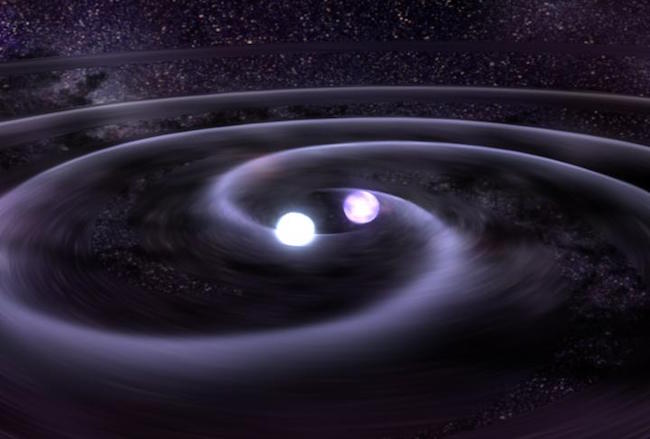
Third-generation gravitational wave (GW) observatories such as the Einstein Telescope (ET) and Cosmic Explorer (CE), are expected to revolutionise the future of multi-messenger astrophysics by detecting ∼ 10^5 binary neutron star (BNS) mergers per year, reaching redshifts well beyond the star formation peak.

The detection and characterisation of the electromagnetic counterparts of these events is crucial to understanding the extreme physics at play. The WST will be ideally suited to perform this task.

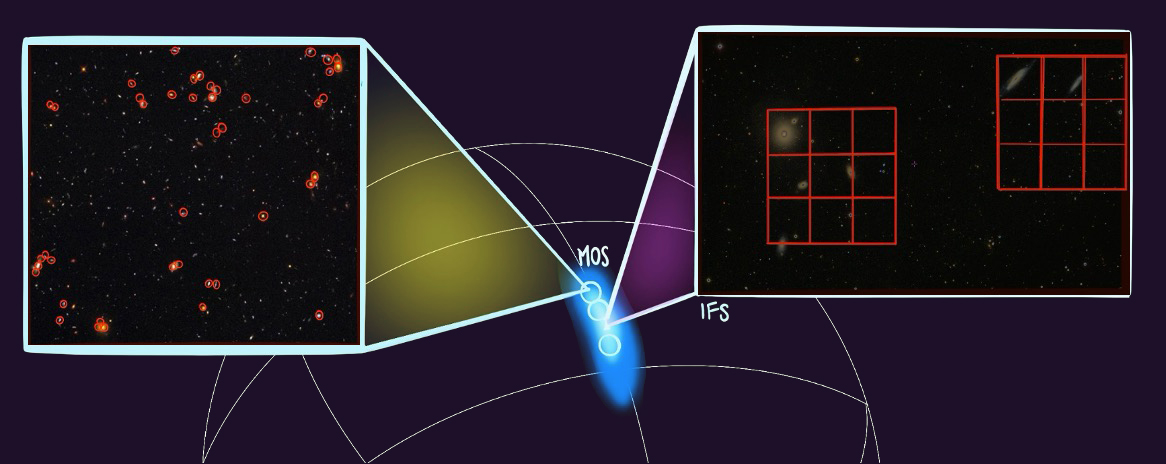
On the one hand, WST ’s extragalactic and cosmology surveys will create an unprecedented catalogue of galaxy redshifts out to z < 2, allowing the correlation with a majority of GW events, even without optical counterparts. On the other hand, GW events with EM counterparts will be followed in timely fashion as Targets of Opportunities (ToOs)  with rapid reaction times. The wide-field of view and high multiplexing of WST is ideally suited to the several square degrees uncertainty on the location on sky of the EM counterpart of such events. 

Artist’s illustration of two compact objects orbiting each other, generating gravitational waves that ripple outward in concentric waves through space against a star-filled background
Credit: NASA/Tod Strohmayer (GSFC)/Dana Berry (Chandra X-Ray Observatory)
Credits: Sofia Bisero

Insight into neutrino mass

Another multi-messenger area in which the WST will provide original contributions would be in the determination of the neutrino mass.

The observation of flavour oscillations of atmospheric and solar neutrinos, as well as oscillation studies at reactors and accelerators, unequivocally proves neutrinos to possess non-zero rest masses, contradicting the Standard Model expectation of them being massless.

A massive neutrino has a direct effect on how primordial perturbations in the early universe propagate. The WST will therefore be able through its cosmological surveys to put stringent upper limits on the neutrino mass.

Synergies

The WST will fill a critical gap in the global astronomical infrastructure of the 2040s.

Next section

New frontiers in cosmology

Understanding how dark matter, dark energy, and gravity shape structure across the Universe requires measurements that span from the smallest galaxies to the largest cosmic environments.

Acronyms

TECHNICAL

WST: Wide-field Spectroscopic Telescope

FoV: Field-of-View

IFS: Integral Field Spectrograph

IFU: Integral Field Unit

MOS: Multi-Object Spectrograph

MOS-HR: High-resolution Multi-Object Spectrograph

MOS-LR: Low-resolution Multi-Object Spectrograph

ToO: Targets of Opportunity

INSTITUTES & UNIVERSITIES

AIP: Leibniz Institute for Astrophysics Potsdam

ANU/Astralis: The Australian National University / Astralis

CRAL/CNRS: Centre de Recherche Astrophysique de Lyon / French National Centre for Scientific Research

EPFL: Swiss Federal Institute of Technology in Lausanne

ESO: European Southern Observatory

IA/CAUP: Institute of Astrophysics and Space Sciences / Centre for Astrophysics of the University of Porto

IASF-MI/INAF: Institute for Space Astrophysics and Cosmic Physics of Milan / National Institute for Astrophysics

IP2I/CNRS: Institute of Physics of the Two Infinities of Lyon / French National Centre for Scientific Research

IRFU/CEA: Institute for Research into the Fundamental Laws of the Universe / French Alternative Energies and Atomic Energy Commission

Lagrange/CNRS: Lagrange Laboratory / French National Centre for Scientific Research

LAM/CNRS: Marseille Astrophysics Laboratory / French National Centre for Scientific Research

MAQC/Astralis: Macquarie University / Astralis

NCAC: Nicolaus Copernicus Astronomical Center

OAArcetri/INAF: Arcetri Astrophysical Observatory / National Institute for Astrophysics

OABrera/INAF:Brera Astronomical Observatory / National Institute for Astrophysics

OACapodimonte/INAF: Capodimonte Astronomical Observatory / National Institute for Astrophysics

OASBologna/INAF:Bologna Observatory of Astrophysics and Space Science / National Institute for Astrophysics

UKRI: UK Research and Innovation

UNIBO: University of Bologna

UNIGRO/NOVA: University of Groningen / The Netherlands Research School for Astronomy

UNISYD: The University of Sydney

UNIVIE: University of Vienna

UWA: The University of Western Australia

Edit Template

Join the community

ue-logo-h
This project has received funding from the European Union Horizon Europe Research and Innovation Action under grant agreement no. 101183153 -WST.
Views and opinions expressed are however those of the author(s) only and do not necessarily reflect those of the European Union or European Research Executive Agency (REA). Neither the European Union nor the granting authority can be held responsible for them.

Acronyms

TECHNICAL

WST: Wide-field Spectroscopic Telescope

FoV: Field-of-View

IFS: Integral Field Spectrograph

IFU: Integral Field Unit

MOS: Multi-Object Spectrograph

MOS-HR: High-resolution Multi-Object Spectrograph

MOS-LR: Low-resolution Multi-Object Spectrograph

ToO: Targets of Opportunity

INSTITUTES & UNIVERSITIES

AIP: Leibniz Institute for Astrophysics Potsdam

ANU/Astralis: The Australian National University / Astralis

CRAL/CNRS: Centre de Recherche Astrophysique de Lyon / French National Centre for Scientific Research

EPFL: Swiss Federal Institute of Technology in Lausanne

ESO: European Southern Observatory

IA/CAUP: Institute of Astrophysics and Space Sciences / Centre for Astrophysics of the University of Porto

IASF-MI/INAF: Institute for Space Astrophysics and Cosmic Physics of Milan / National Institute for Astrophysics

IP2I/CNRS: Institute of Physics of the Two Infinities of Lyon / French National Centre for Scientific Research

IRFU/CEA: Institute for Research into the Fundamental Laws of the Universe / French Alternative Energies and Atomic Energy Commission

Lagrange/CNRS: Lagrange Laboratory / French National Centre for Scientific Research

LAM/CNRS: Marseille Astrophysics Laboratory / French National Centre for Scientific Research

MAQC/Astralis: Macquarie University / Astralis

NCAC: Nicolaus Copernicus Astronomical Center

OAArcetri/INAF: Arcetri Astrophysical Observatory / National Institute for Astrophysics

OABrera/INAF:Brera Astronomical Observatory / National Institute for Astrophysics

OACapodimonte/INAF: Capodimonte Astronomical Observatory / National Institute for Astrophysics

OASBologna/INAF:Bologna Observatory of Astrophysics and Space Science / National Institute for Astrophysics

UKRI: UK Research and Innovation

UNIBO: University of Bologna

UNIGRO/NOVA: University of Groningen / The Netherlands Research School for Astronomy

UNISYD: The University of Sydney

UNIVIE: University of Vienna

UWA: The University of Western Australia

Edit Template
ue-logo-h
This project has received funding from the European Union Horizon Europe Research and Innovation Action under grant agreement no. 101183153 -WST.
Views and opinions expressed are however those of the author(s) only and do not necessarily reflect those of the European Union or European Research Executive Agency (REA). Neither the European Union nor the granting authority can be held responsible for them.