

Understanding how dark matter, dark energy, and gravity shape structure across the Universe requires measurements that span from the smallest galaxies to the largest cosmic environments.
The WST will provide this essential multiprobe view, combining local and high-redshift galaxy surveys, cosmic-web mapping, and gravitational-wave counterparts to reveal deviations from standard cosmology.
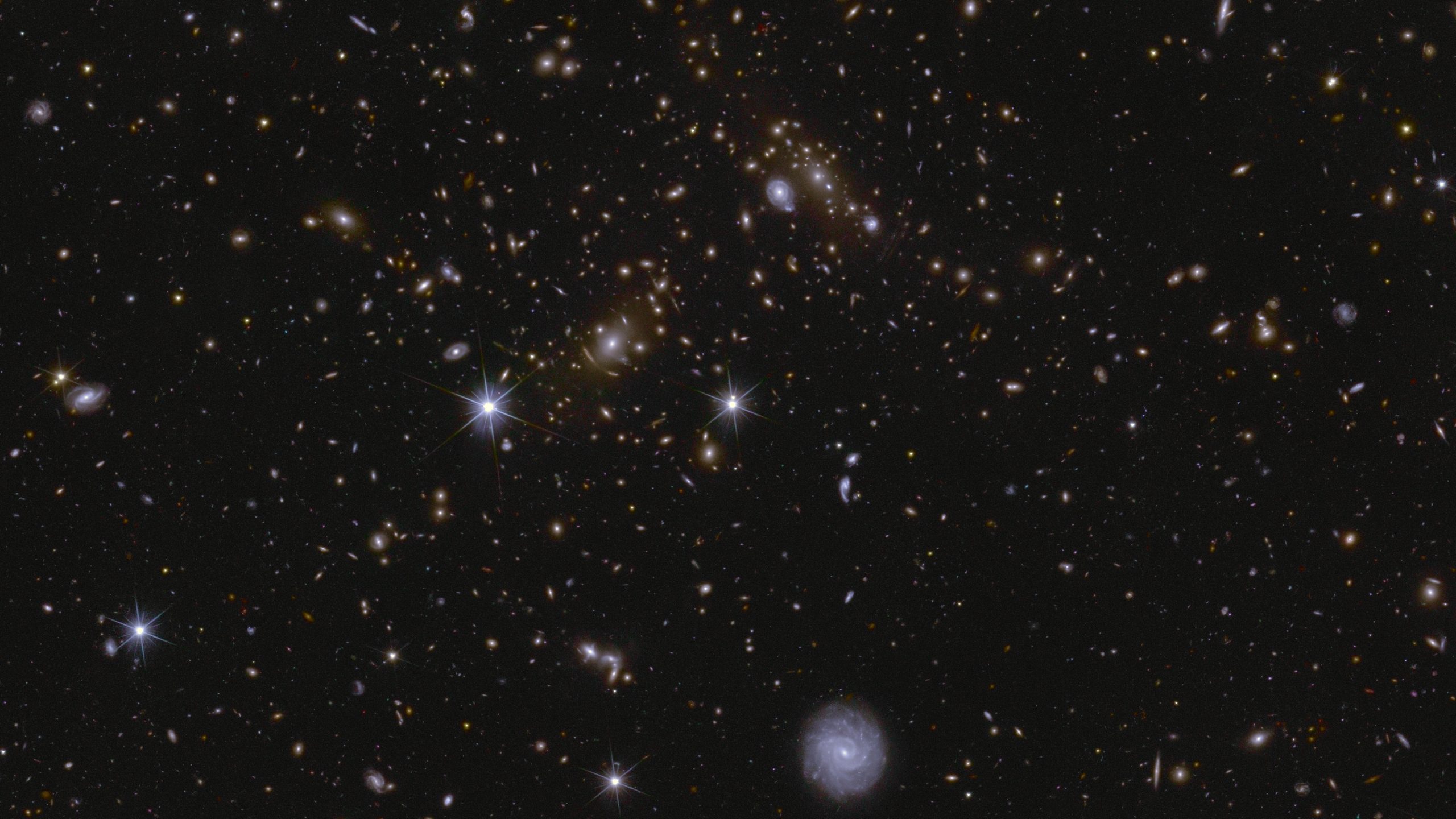
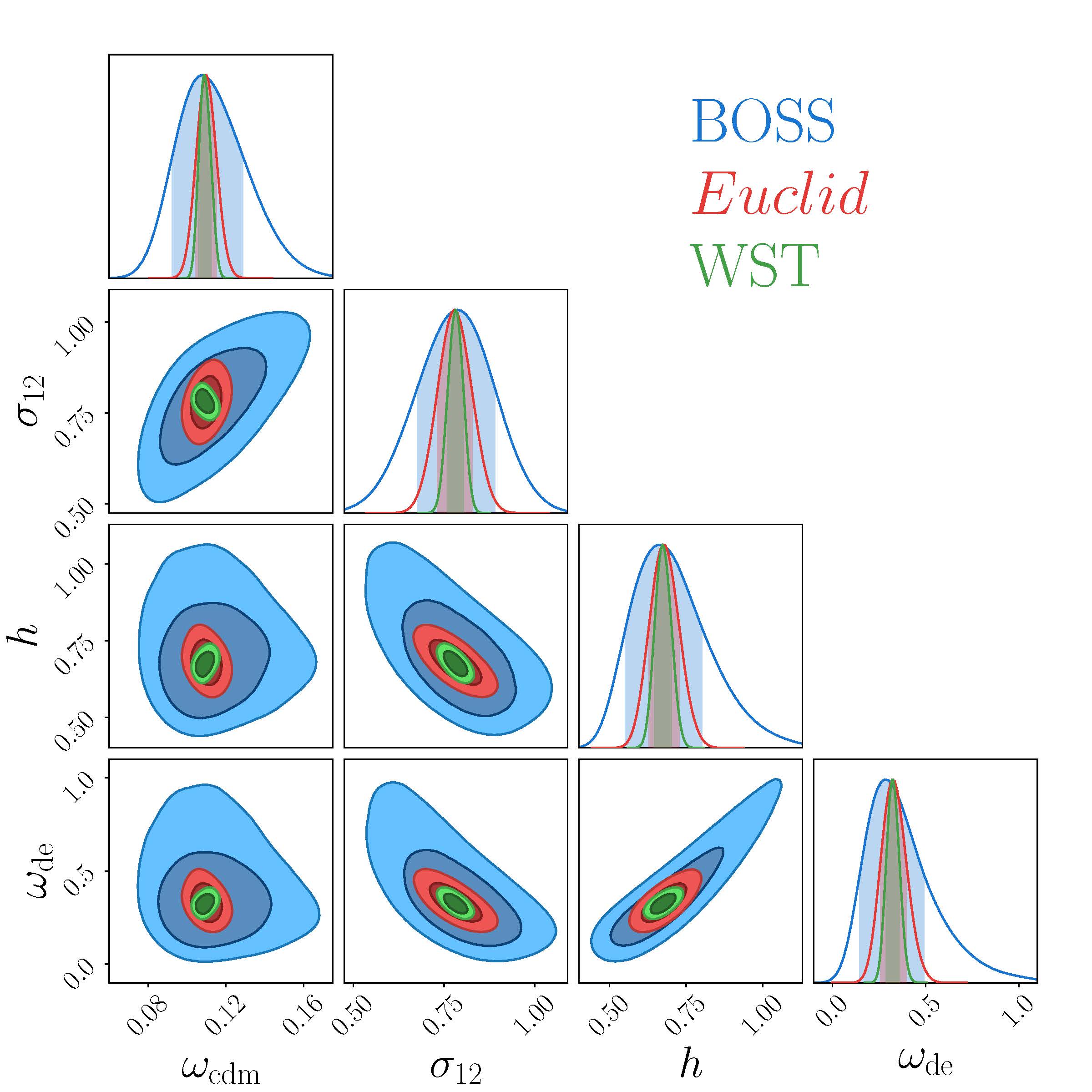
Galaxy clusters, filaments, and voids have different sensitivities to dark matter, dark energy, and neutrinos. The WST will uniquely sample this wide range of environments on a large volume of the Universe which would provide exceptionally tight combined constraints, capable of breaking intrinsic parameter degeneracies within the standard cosmological model, while also opening a new window to the exploration of alternative cosmologies such as modified gravity, evolving dark energy, and primordial non-Gaussianity.
The synergy between the WST and next-generation Gravitational Waves (GWs) facilities such as the Einstein Telescope (ET) represents a very promising avenue to test modified gravity at higher redshifts, where deviations from General Relativity might be most pronounced. The ET will detect thousands of binary black holes annually out to z > 5, while the WST, by obtaining spectroscopic redshifts of potential host galaxies for binary black hole mergers (BBH), will probe whether GWs propagate differently from light over cosmological distances. GW will be used as dark sirens to test gravity across cosmic time, potentially uncovering new physics that could revolutionize our understanding of dark energy and cosmic acceleration.
Further tests on modified gravity and deviations from General Relativity (GR) could be performed with the WST on Mpc scales using the peculiar velocity distribution of cluster member galaxies.
Determining the fundamental nature of dark matter (DM) is still a crucial question in astrophysics, and no unique particle candidate has been constrained. In the standard Cold Dark Matter (CDM) paradigm, DM consists of collisionless non-relativistic particles with negligible non-gravitational interactions. While this hypothesis is successful on large physical scales, it faces the same challenges on small galactic scales.
The WST will be able to perform a systematic survey of Local Group and Local Volume dwarf galaxies to elucidate whether the challenges of CDM on small galactic scales stern from poorly understood fundamental baryonic processes or instead indicate that alternative DM scenarios need to be considered.
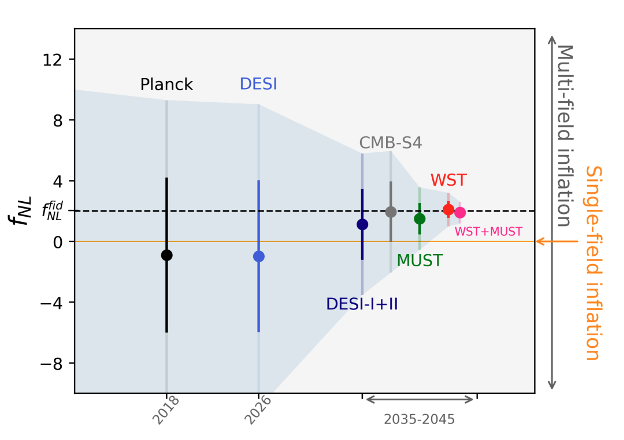
Finally, the WST will be unique in carrying out a high-density, wide-area spectroscopic survey targeting multiple tracers, including emission-line galaxies (ELGs), luminous red galaxies (LRGs), and quasars (QSOs).
This will allow measuring the large-scale clustering of galaxies and quasars across a wide redshift range (z ≈ 1 to 5.5) and achieve precise constraints on primordial non-Gaussianity. The WST will uniquely allow us to test inflationary models beyond the standard single-field scenario.
The WST will fill a critical gap in the global astronomical infrastructure of the 2040s.
the Physics of the Early Universe, first stars and first galaxies.
Unveiling the cosmic web with the WST
Issue #2 The WST Chronicle