

WST Operations

The WST Operations Work Package is dedicated to designing the science-driven operational framework and data flow architecture that will enable WST to deliver its ambitious scientific goals.

From survey design and scheduling to data reduction, analysis, and long-term archiving, Operations defines how WST will function on a daily and strategic level. The primary goal is to ensure a sustainable, flexible system capable of running multiple surveys in parallel while consistently producing high-quality, science-ready data products.

The Facility Simulator

A cornerstone of the Operations Work Package is the Facility Simulator—a prototype survey planner and target allocation tool developed in collaboration with the Survey Planning team.

The Simulator will optimize observing efficiency across multiple simultaneous surveys—both multi-object spectroscopy (MOS) and integral-field spectroscopy (IFS)—while maintaining the agility to incorporate Targets of Opportunity and time-domain programs. This balance between efficiency and adaptability is essential to fulfilling WST’s scientific mission.

Data Reduction and Analysis Pipelines (both MOS and IFS)

The WST will operate on a scale far beyond current spectroscopic facilities. While existing data processing frameworks will be carefully assessed, new pipelines will be developed to meet WST’s unique requirements.

Beyond traditional reduction workflows, Operations will explore advanced data analysis methods, including machine learning and data mining, to fully exploit the unprecedented volume of data. Efforts will be done to provide a flexible architecture for science users to plug-in specialized analysis tools.

Sustainability is a key consideration. The outdated assumption that “computing is cheap” no longer holds. Power consumption, data transfer, and hardware costs must be carefully optimized. We will evaluate trade-offs between on-site processing, remote data centers, and near-archive reduction, ensuring efficiency while minimizing environmental impact. Meanwhile, advances in artificial intelligence promise to revolutionize operations—from automated data reduction and analysis to adaptive scheduling—enhancing both capability and efficiency.

Archive and Data Management

The WST Archive and Data Management System will store millions of spectra and data cubes in an accessible, sustainable, and standards-compliant way.

Comprehensive metadata tracking and quality control will be embedded throughout the data flow, ensuring alignment with FAIR principles and Virtual Observatory standards. Handling such immense data volumes—augmented by telescope telemetry, monitoring data, and real-time alerts—represents a significant challenge, demanding innovative design and robust scalability.

Science Operations Concept

The Science Operational Concept provides the overarching framework that integrates MOS and IFS observing modes, despite their differing requirements for exposure cycles and calibration.


Designed with time-domain science in mind, the concept ensures efficient, dynamic operations that can respond to variable and transient phenomena. The Science Data Flow is central to this effort, enabling raw data to be transferred, processed, and quality-checked in near real time—an essential capability for time-critical observations and automated alerting.

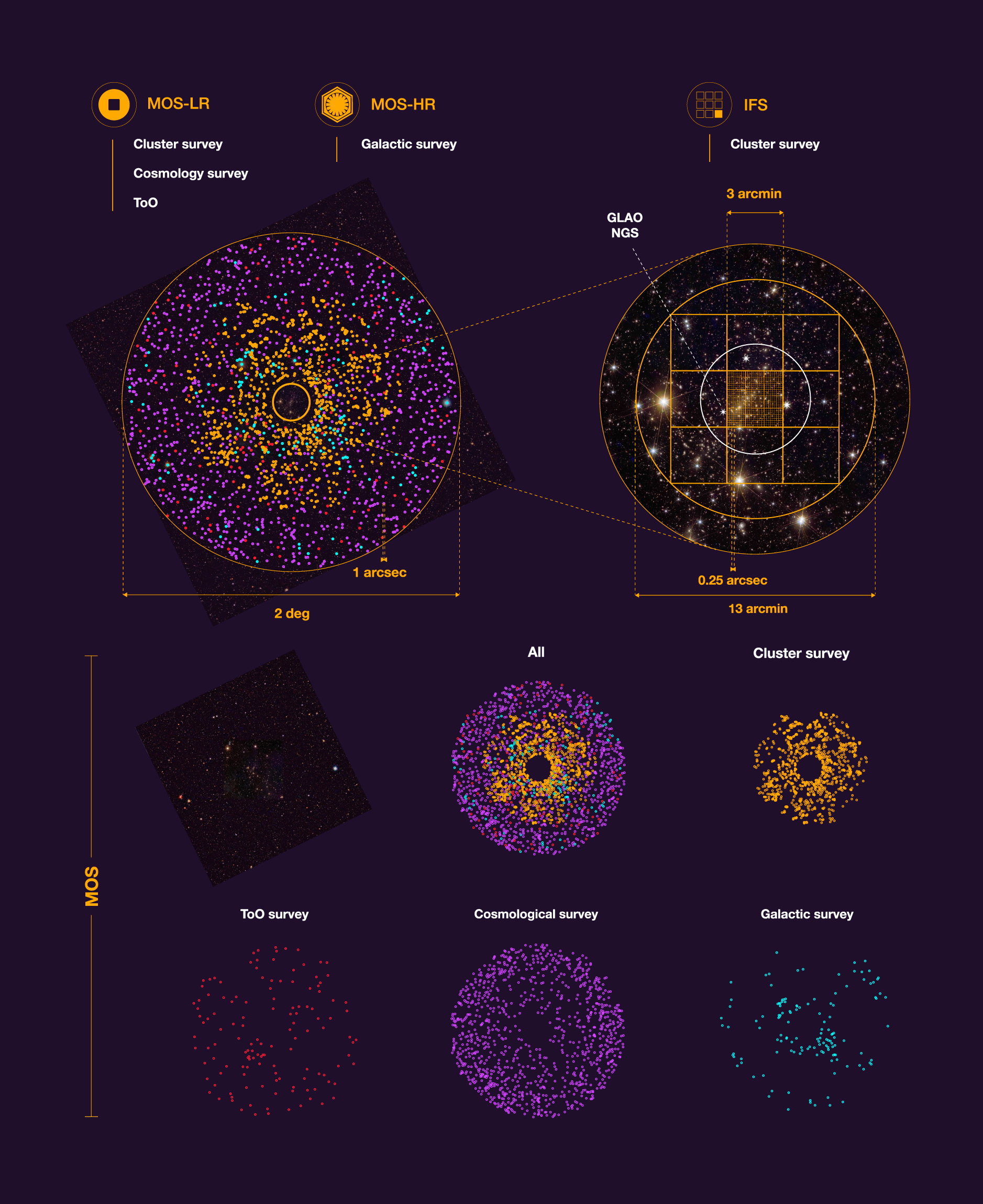
The massive cluster survey is an example of multi-scale, multi-survey optimum use of the WST capabilities. The central region of the Abell 2390 cluster will be imaged by the IFS, whose field of view is ideally suited to probing the strong lensing region, either with a single 3×3 arcmin² pointing (700 kpc at the cluster distance) or through a mosaic of IFS observations. Sufficiently bright stars are present within the surrounding 6 arcmin diameter technical field of view to enable effective GLAO correction, delivering superb image quality across the IFS field. At the same time, a fraction of the 30,000 MOS-LR fibers can be dedicated to tracing the distribution of cluster galaxies on Mpc scales, providing key insights into the cosmic web structure surrounding the massive cluster. The remaining MOS-LR fibers can be used in parallel for large-scale cosmology surveys, while MOS-HR fibers will measure chemical abundances in Milky Way halo stars. Finally, alerts from photometric time-domain surveys (e.g., LSST) will enable the observation of targets of opportunity (ToO), using a pre-allocated subset of MOS-LR fibers. Credits: M.C. Fortuna and R. Bacon/WST. The Abell 2390 central image is from Euclid: ESA/Euclid/Euclid Consortium/NASA, image processing by J.-C. Cuillandre (CEA Paris-Saclay) and G. Anselmi. The large scale 2- degree image centered on the cluster is from Pan-Starrs (Pan-STARRS1 Surveys (PS1), Institute for Astronomy, University of Hawaii).

Towards a Transformational Era

The WST will generate data volumes unprecedented at ESO, marking a major step into the era of astronomical big data. By learning from current survey facilities, critically assessing existing methods, and developing innovative new approaches, the Operations Work Package will define a robust, future-ready operational model.

Our mission is to transform raw photons into science-ready data products that will deliver an enduring spectroscopic legacy for the global astronomical community.

Next section

the WST needs to be placed in an adequate site

Excellent seeing, clear nights, and low light pollution. Selecting such a site is part of a comprehensive process that involves the investigation and simulation of multiple aspects.

Acronyms

TECHNICAL

WST: Wide-field Spectroscopic Telescope

FoV: Field-of-View

IFS: Integral Field Spectrograph

IFU: Integral Field Unit

MOS: Multi-Object Spectrograph

MOS-HR: High-resolution Multi-Object Spectrograph

MOS-LR: Low-resolution Multi-Object Spectrograph

ToO: Targets of Opportunity

INSTITUTES & UNIVERSITIES

AIP: Leibniz Institute for Astrophysics Potsdam

ANU/Astralis: The Australian National University / Astralis

CRAL/CNRS: Centre de Recherche Astrophysique de Lyon / French National Centre for Scientific Research

EPFL: Swiss Federal Institute of Technology in Lausanne

ESO: European Southern Observatory

IA/CAUP: Institute of Astrophysics and Space Sciences / Centre for Astrophysics of the University of Porto

IASF-MI/INAF: Institute for Space Astrophysics and Cosmic Physics of Milan / National Institute for Astrophysics

IP2I/CNRS: Institute of Physics of the Two Infinities of Lyon / French National Centre for Scientific Research

IRFU/CEA: Institute for Research into the Fundamental Laws of the Universe / French Alternative Energies and Atomic Energy Commission

Lagrange/CNRS: Lagrange Laboratory / French National Centre for Scientific Research

LAM/CNRS: Marseille Astrophysics Laboratory / French National Centre for Scientific Research

MAQC/Astralis: Macquarie University / Astralis

NCAC: Nicolaus Copernicus Astronomical Center

OAArcetri/INAF: Arcetri Astrophysical Observatory / National Institute for Astrophysics

OABrera/INAF:Brera Astronomical Observatory / National Institute for Astrophysics

OACapodimonte/INAF: Capodimonte Astronomical Observatory / National Institute for Astrophysics

OASBologna/INAF:Bologna Observatory of Astrophysics and Space Science / National Institute for Astrophysics

UKRI: UK Research and Innovation

UNIBO: University of Bologna

UNIGRO/NOVA: University of Groningen / The Netherlands Research School for Astronomy

UNISYD: The University of Sydney

UNIVIE: University of Vienna

UWA: The University of Western Australia

Edit Template

Join the community

ue-logo-h
This project has received funding from the European Union Horizon Europe Research and Innovation Action under grant agreement no. 101183153 -WST.
Views and opinions expressed are however those of the author(s) only and do not necessarily reflect those of the European Union or European Research Executive Agency (REA). Neither the European Union nor the granting authority can be held responsible for them.

Acronyms

TECHNICAL

WST: Wide-field Spectroscopic Telescope

FoV: Field-of-View

IFS: Integral Field Spectrograph

IFU: Integral Field Unit

MOS: Multi-Object Spectrograph

MOS-HR: High-resolution Multi-Object Spectrograph

MOS-LR: Low-resolution Multi-Object Spectrograph

ToO: Targets of Opportunity

INSTITUTES & UNIVERSITIES

AIP: Leibniz Institute for Astrophysics Potsdam

ANU/Astralis: The Australian National University / Astralis

CRAL/CNRS: Centre de Recherche Astrophysique de Lyon / French National Centre for Scientific Research

EPFL: Swiss Federal Institute of Technology in Lausanne

ESO: European Southern Observatory

IA/CAUP: Institute of Astrophysics and Space Sciences / Centre for Astrophysics of the University of Porto

IASF-MI/INAF: Institute for Space Astrophysics and Cosmic Physics of Milan / National Institute for Astrophysics

IP2I/CNRS: Institute of Physics of the Two Infinities of Lyon / French National Centre for Scientific Research

IRFU/CEA: Institute for Research into the Fundamental Laws of the Universe / French Alternative Energies and Atomic Energy Commission

Lagrange/CNRS: Lagrange Laboratory / French National Centre for Scientific Research

LAM/CNRS: Marseille Astrophysics Laboratory / French National Centre for Scientific Research

MAQC/Astralis: Macquarie University / Astralis

NCAC: Nicolaus Copernicus Astronomical Center

OAArcetri/INAF: Arcetri Astrophysical Observatory / National Institute for Astrophysics

OABrera/INAF:Brera Astronomical Observatory / National Institute for Astrophysics

OACapodimonte/INAF: Capodimonte Astronomical Observatory / National Institute for Astrophysics

OASBologna/INAF:Bologna Observatory of Astrophysics and Space Science / National Institute for Astrophysics

UKRI: UK Research and Innovation

UNIBO: University of Bologna

UNIGRO/NOVA: University of Groningen / The Netherlands Research School for Astronomy

UNISYD: The University of Sydney

UNIVIE: University of Vienna

UWA: The University of Western Australia

Edit Template
ue-logo-h
This project has received funding from the European Union Horizon Europe Research and Innovation Action under grant agreement no. 101183153 -WST.
Views and opinions expressed are however those of the author(s) only and do not necessarily reflect those of the European Union or European Research Executive Agency (REA). Neither the European Union nor the granting authority can be held responsible for them.