The

Wide-field
Spectroscopic
Telescope

Wide-field
Spectroscopic
Telescope

Pushing the Boundaries of
Spectroscopic Surveys

IFS FoV
0 x3'
MOS FoV
0 sq. deg.
at Low Resolution (MOS)
0 targets
at High Resolution (MOS)
0 targets

THE WST DEEP DIVE

Unpacking the project’s core pillars

The WST will be pivotal, in synergy with other major astronomical facilities in the 2040s, to tackle some of the key open questions in modern astrophysics.

Astronomy has entered the era of data-driven discovery. To fully exploit this wealth of multi-wavelength information, spectroscopy is essential, as it can add further dimensions.

The WST Operations Work Package is dedicated to designing the science-driven operational framework and data flow architecture that will enable WST to deliver its ambitious scientific goals.

The WST considers sustainability a core value guiding both the development of the facility and the activities of the consortium. A dedicated cross-disciplinary group supports this commitment by developing guidelines, particularly for the design and construction phases.

Observatory

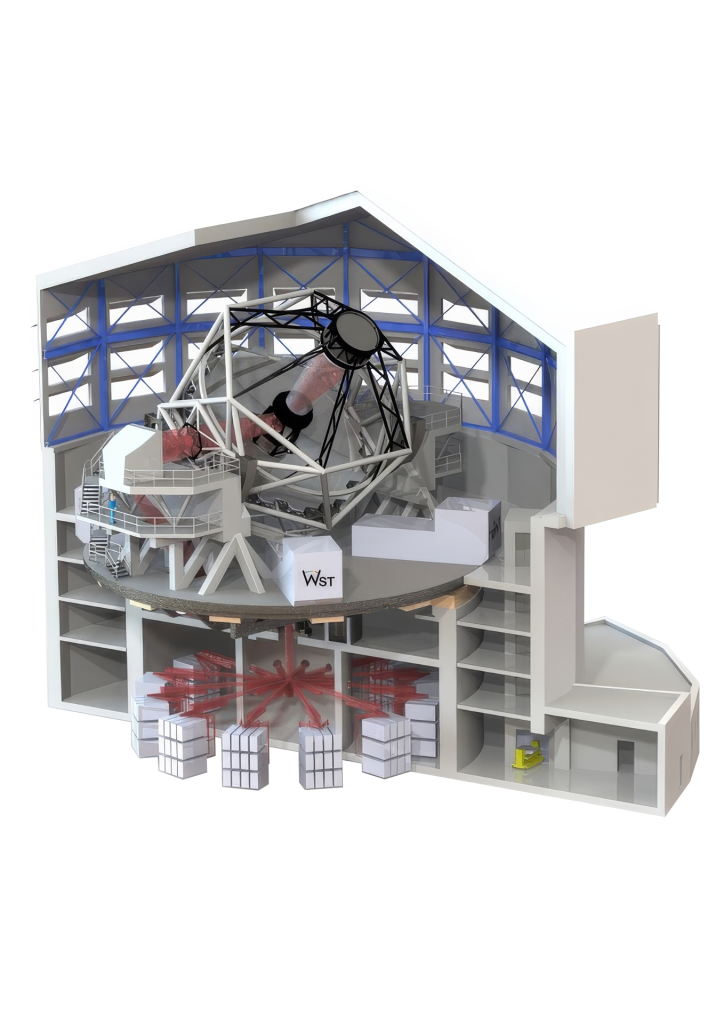
The Facility

Credits: G. Gausachs / WST

An innovative 12-m class wide-field spectroscopic telescope (WST) with simultaneous operation of a large field-of-view (FoV, 3 sq. degree) and high multiplex (30,000) multi-object spectrograph facility with both medium and high resolution modes (MOS), and a giant panoramic (3×3 sq. arcmin) integral field spectrograph (IFS).

Credits: G. Gausachs / WST

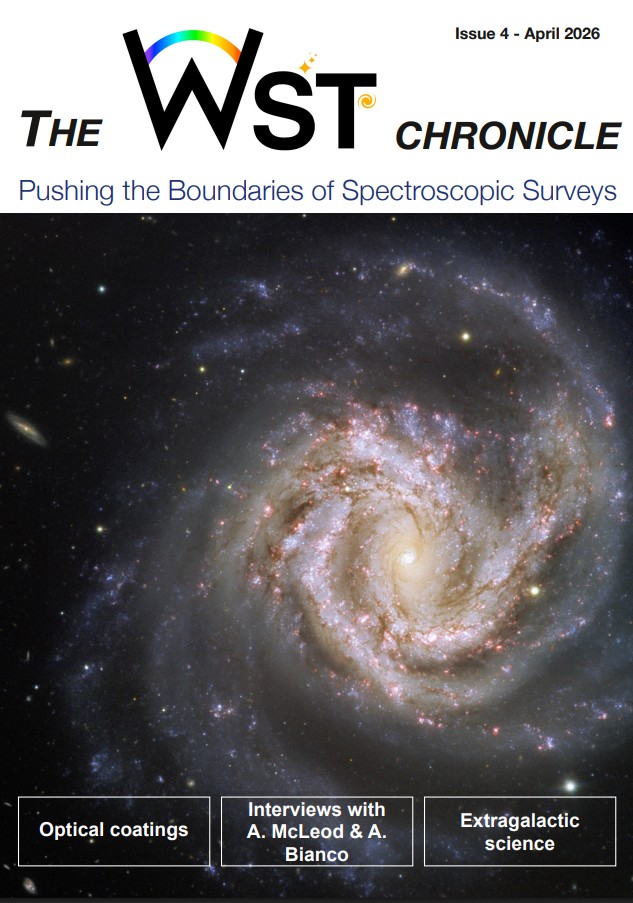
The WST Chronicle

The WST Chronicle is a tri-monthly magazine that provides a platform for communicating progress within the WST consortium while serving as a bridge to the wider community.

THE WST People

MEET THE TEAM BEHIND THE PROJECT

THE WST Consortium

Research institutes & universities over 12 countries

The WST consortium brings together the Horizon Consortium, comprising 23 research institutes, and a much broader Science Team. All consortium members adhere to the WST Code of Conduct and Publication Policy.

Join us

The WST project is committed to an open-science policy, allowing any professional astronomer to join the Science Team.

Frequently asked questions

The great quests of modern astrophysics and cosmology

Is the accelerated expansion of the Universe due to an unknown form of energy or to a modification of General Relativity on large scales?

What signatures of new physics from inflation and the early Universe are present in the clustering of high redshift galaxies?

How do black holes form and grow over cosmic time?

What is the interplay between dark, stellar, and gaseous material in galaxies, and how does primordial and metal-enriched gas flow in and out of galaxies at various scales during different epochs?

What is the detailed formation and accretion history of the Milky Way, its populations, and its satellites?

What is the detailed formation and accretion history of the Milky Way, its populations, and its satellites?

The WST main challenges

The great quests of modern astrophysics and cosmology

Item content. Click the edit button to change this text.

Item content. Click the edit button to change this text.

Item content. Click the edit button to change this text.

Nobis atque id hic neque possimus voluptatum voluptatibus tenetur, perspiciatis consequuntur. Lorem ipsum dolor sit amet, consectetur adipisicing elit. Minima incidunt voluptates nemo, dolor optio quia architecto quis delectus perspiciatis.

Nobis atque id hic neque possimus voluptatum voluptatibus tenetur, perspiciatis consequuntur. Lorem ipsum dolor sit amet, consectetur adipisicing elit. Minima incidunt voluptates nemo, dolor optio quia architecto quis delectus perspiciatis.

Acronyms

TECHNICAL

WST: Wide-field Spectroscopic Telescope

FoV: Field-of-View

IFS: Integral Field Spectrograph

IFU: Integral Field Unit

MOS: Multi-Object Spectrograph

MOS-HR: High-resolution Multi-Object Spectrograph

MOS-LR: Low-resolution Multi-Object Spectrograph

ToO: Targets of Opportunity

INSTITUTES & UNIVERSITIES

AIP: Leibniz Institute for Astrophysics Potsdam

ANU/Astralis: The Australian National University / Astralis

CRAL/CNRS: Centre de Recherche Astrophysique de Lyon / French National Centre for Scientific Research

EPFL: Swiss Federal Institute of Technology in Lausanne

ESO: European Southern Observatory

IA/CAUP: Institute of Astrophysics and Space Sciences / Centre for Astrophysics of the University of Porto

IASF-MI/INAF: Institute for Space Astrophysics and Cosmic Physics of Milan / National Institute for Astrophysics

IP2I/CNRS: Institute of Physics of the Two Infinities of Lyon / French National Centre for Scientific Research

IRFU/CEA: Institute for Research into the Fundamental Laws of the Universe / French Alternative Energies and Atomic Energy Commission

Lagrange/CNRS: Lagrange Laboratory / French National Centre for Scientific Research

LAM/CNRS: Marseille Astrophysics Laboratory / French National Centre for Scientific Research

MAQC/Astralis: Macquarie University / Astralis

NCAC: Nicolaus Copernicus Astronomical Center

OAArcetri/INAF: Arcetri Astrophysical Observatory / National Institute for Astrophysics

OABrera/INAF:Brera Astronomical Observatory / National Institute for Astrophysics

OACapodimonte/INAF: Capodimonte Astronomical Observatory / National Institute for Astrophysics

OASBologna/INAF:Bologna Observatory of Astrophysics and Space Science / National Institute for Astrophysics

UKRI: UK Research and Innovation

UNIBO: University of Bologna

UNIGRO/NOVA: University of Groningen / The Netherlands Research School for Astronomy

UNISYD: The University of Sydney

UNIVIE: University of Vienna

UWA: The University of Western Australia

Edit Template

Join the community

ue-logo-h
This project has received funding from the European Union Horizon Europe Research and Innovation Action under grant agreement no. 101183153 -WST.
Views and opinions expressed are however those of the author(s) only and do not necessarily reflect those of the European Union or European Research Executive Agency (REA). Neither the European Union nor the granting authority can be held responsible for them.