

Galaxy assembly across physical scale

Galaxy evolution unfolds across an immense range of physical scales, from star formation in parsec-sized molecular clouds to kiloparsec-scale secular evolution and galactic flows, to megaparsec-scale cosmic environments. Understanding the interplay between galaxies, their dark matter haloes, and the large-scale structures has long been limited by observational gaps across these regimes. The WST will bridge these scales with unprecedented accuracy and statistical power, offering a unified view of galaxy evolution.

Galaxy assembly in the Cosmic Web

Key star formation physics occurs below ~100 pc, where the Schmidt–Kennicutt law breaks down, and the cycle between clouds, HII regions, and star clusters can be resolved. The large field-of-view of the WST IFS, coupled with cloud scale resolution, will be essential for linking nebulae to their ionising sources for direct measurements of feedback pressures, escape fractions, and enrichment processes.

The WST will be able to perform a SDSS-like survey of several millions of galaxies across a wide range of redshifts (z~0.2-1.5) over ~150 sq. degrees, thereby providing a comprehensive map of the matter and galaxy distributions, enabling us to link the photometric and spectral properties (and inferred physical properties) of galaxies to the cosmic web structures on scales of 10 s to 100 Mpc (from filaments to groups and rich clusters).

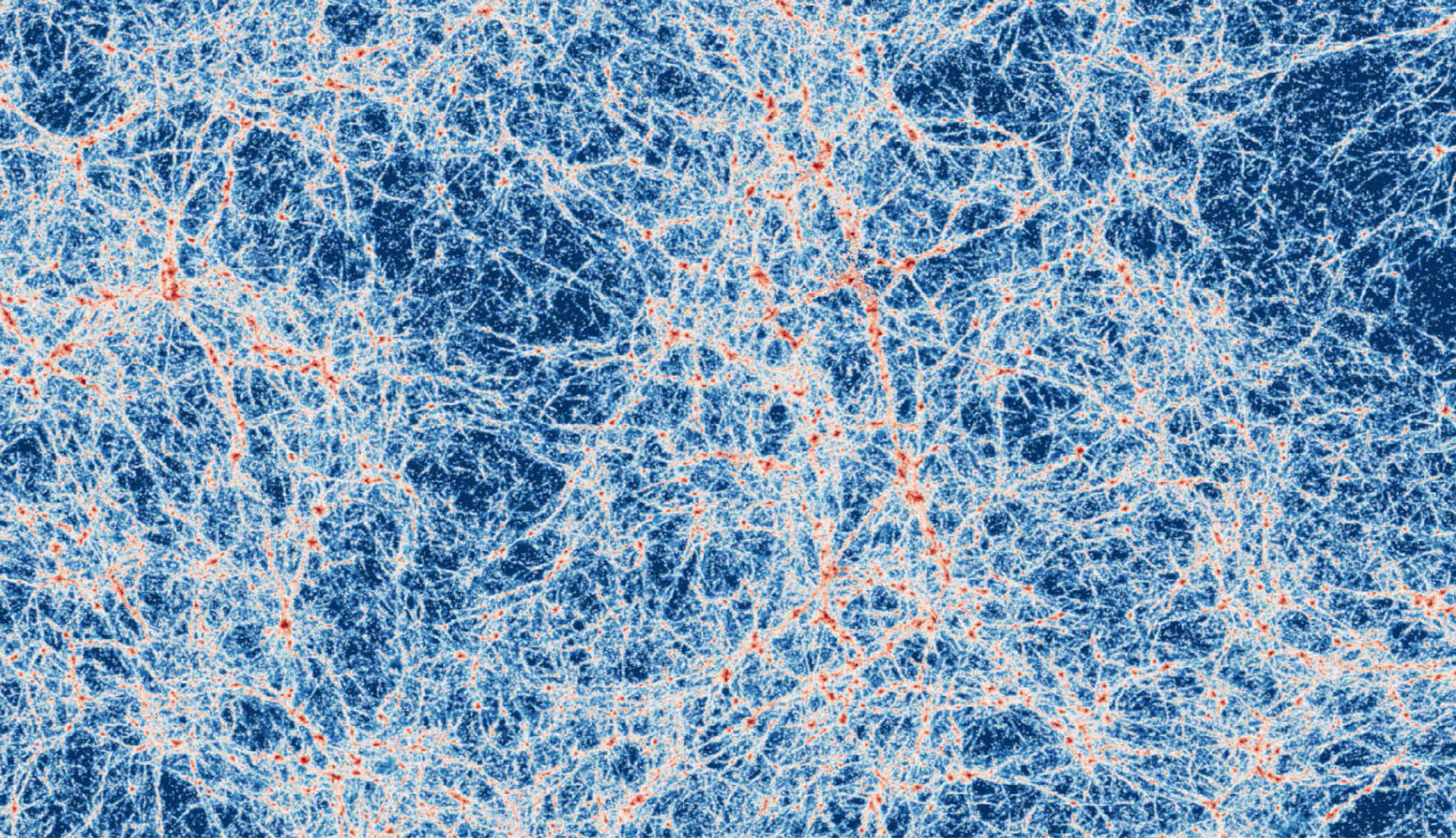
Cosmic web visualization showing white and pink filaments on a deep blue background, illustrating the Universe's large-scale structure.
A density map of the gas distributed on scales of ~40 cMpc reveals an intricate network of filaments (in white) that make up the cosmic web. Directly mapping this gas network and its connection to galaxies in cosmologically representative regions of the Universe is a critical missing element in our view of galaxy formation and evolution. Credits: Alejandro Benitez-Llambay/Universität Mailand-Bicocca/MPA
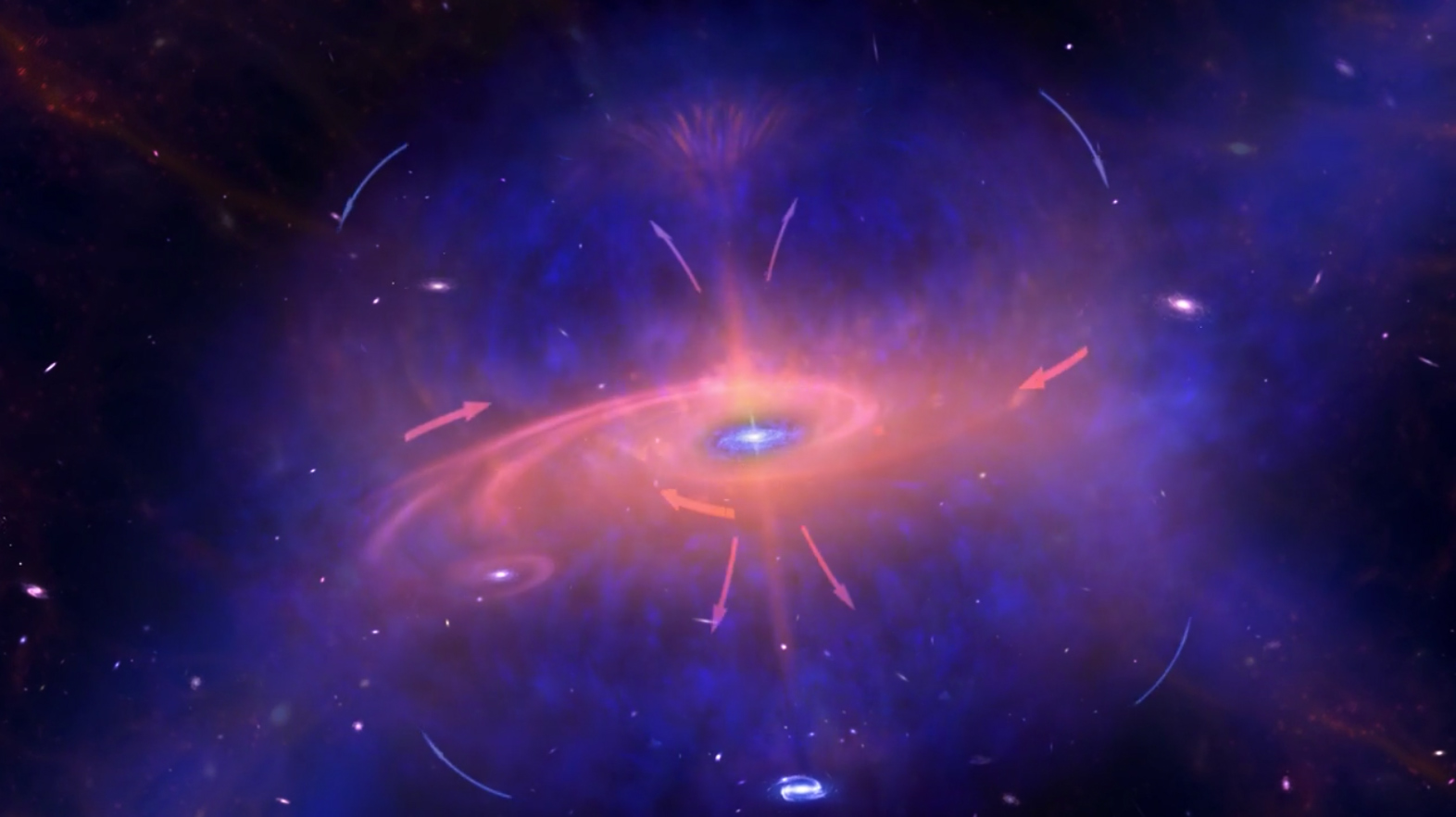
Cartoon of the circum-galactic medium and gas recycling in a galaxy: blue filaments flow into the galaxy, while pink gas flows outward and surrounds it.
Cartoon view of the CGM. The central galaxy is fed by filamentary accretion from the cosmic web (blue). Outflows emerge from the galaxy, enriching the CGM (pink): some of this gas escapes the halo, some is recycled back into the central galaxy. The CGM is a dynamical and multiphase cosmic interface where a large diversity of physical mechanisms occurs at different spatial and temporal scales. Credits: Tsinghua University.


The WST will be able to map the gas in filaments in cosmologically representative portions of the Cosmic Web, which will allow us to understand how diffuse matter is distributed in the intergalactic medium, measure the morphology of those filaments, study their kinematics, and topological properties. At the same time, it will be possible to directly image the Circum-galactic Medium in a large sample of galaxies, therefore allowing us to understand how gas flows in and out of galaxies and how these processes are connected to the distribution of matter on the large scales sampled by the Cosmic Web. 

The Galaxy as a Rosetta Stone for galaxy assembly

The Milky Way (MW) and its satellite galaxies are the environment in which the cosmological paradigms of galaxy formation can be put to the most stringent and detailed tests. The unique power of the WST for resolved stellar studies will be in large scale surveys of targets of all types, including also pulsating stars, throughout the Milky Way and in resolved galaxies providing stellar radial velocities and chemical abundances at the faint end of the Gaia and Rubin LSST catalogues. The combination of the WST LR and HR data, along with the IFS in crowded regions, will greatly expand our view of the Milky Way and provide a powerful perspective on galaxy assembly that is complementary to high-redshift studies.

Some of the science questions that will be addressed include: how do the diverse in situ and accreted stellar populations in the Milky Way and its surroundings compare to galaxy formation and evolution models? Can we uniquely determine the complete accretion history over time? How did the bulge form? How old is the stellar disc?

Just to make a few specific examples, the WST will provide a full mapping of the Milky Way’s halo phase space, disentangling the numerous stellar substructures, remnants of past dwarf galaxies and globular clusters, that it harbors. At the same time, identification of ancient stars in the inner Galaxy can place constraints on early nucleosynthesis and the formation of the first generations of stars in environments similar to those being observed at high redshift.
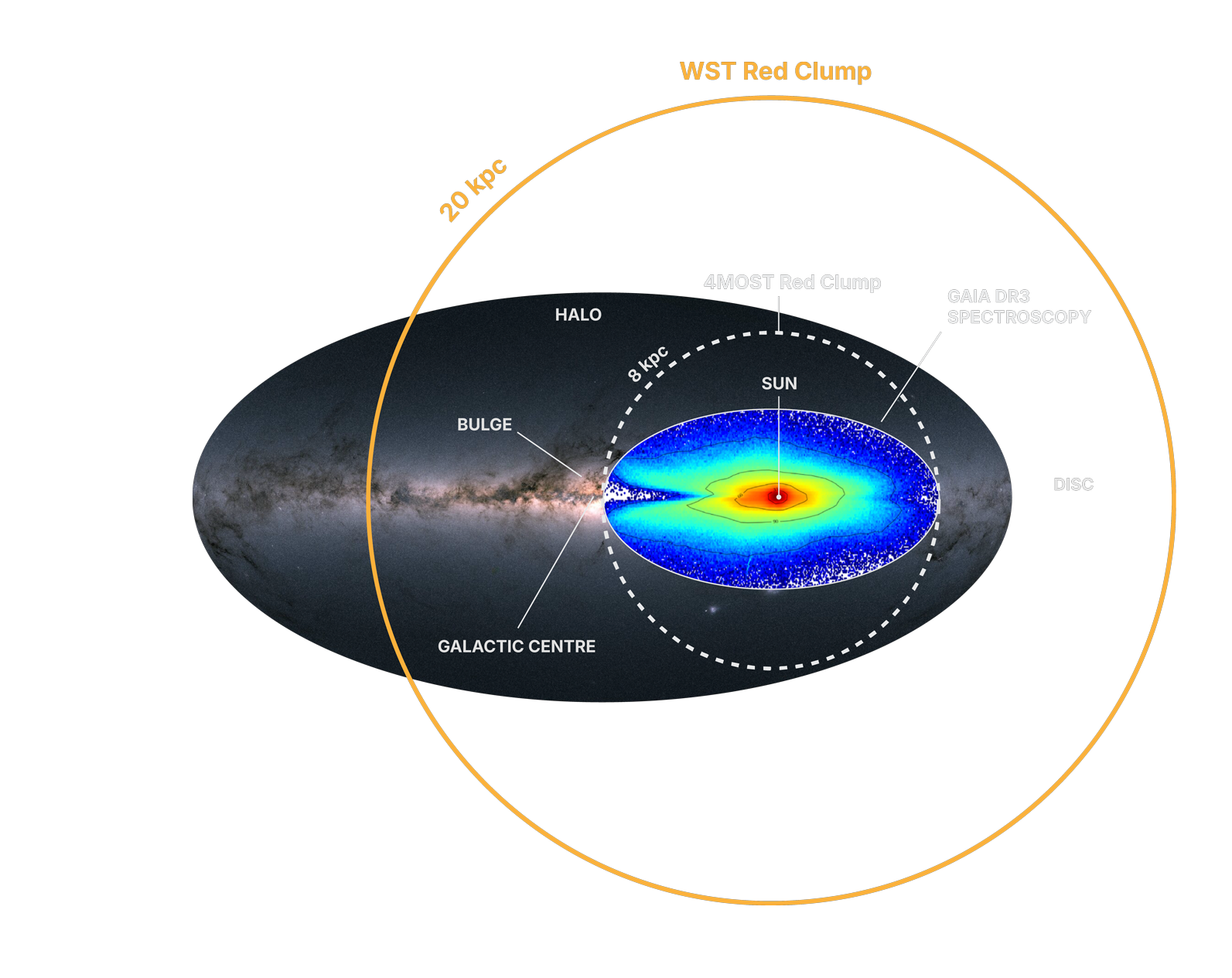
The WST will also investigate the origin and evolution of in-situ stellar populations across the Galactic disc, bar, and bulge. It will deliver low- and high-resolution spectroscopy over >30,000 sq. deg., yielding homogeneous abundances, ages (also using the so-called “cosmic-clocks”), and 6D kinematics for tens of millions of stars out to 20 kpc. This will reconstruct the disc’s star-formation history, constrain inside-out growth and gas accretion, trace echoes of past interactions, probe the primitive disc, and link the bulge to globular clusters, the nuclear disc, and the nuclear star cluster.

Diagram of the Milky Way with labeled regions and highlighted survey areas from Gaia, 4MOST, and WST, with WST covering the largest region.
WST MOS-HR - Credit: Laura Magrini/WST/INAF. Background image: ESA/Gaia/DPAC, CC BY-SA 3.0 IGO. Gaia DR3 density plot: A. Moitinho, University of Lisbon, Portugal/Esa/Gaia/DPAC

Synergies

The WST will fill a critical gap in the global astronomical infrastructure of the 2040s.

Next section

Multi-messenger astrophysics 

Multi-messenger astronomy has been identified as a priority in most major astrophysics planning exercises and will be mainstream in the WST era.  

Acronyms

TECHNICAL

WST: Wide-field Spectroscopic Telescope

FoV: Field-of-View

IFS: Integral Field Spectrograph

IFU: Integral Field Unit

MOS: Multi-Object Spectrograph

MOS-HR: High-resolution Multi-Object Spectrograph

MOS-LR: Low-resolution Multi-Object Spectrograph

ToO: Targets of Opportunity

INSTITUTES & UNIVERSITIES

AIP: Leibniz Institute for Astrophysics Potsdam

ANU/Astralis: The Australian National University / Astralis

CRAL/CNRS: Centre de Recherche Astrophysique de Lyon / French National Centre for Scientific Research

EPFL: Swiss Federal Institute of Technology in Lausanne

ESO: European Southern Observatory

IA/CAUP: Institute of Astrophysics and Space Sciences / Centre for Astrophysics of the University of Porto

IASF-MI/INAF: Institute for Space Astrophysics and Cosmic Physics of Milan / National Institute for Astrophysics

IP2I/CNRS: Institute of Physics of the Two Infinities of Lyon / French National Centre for Scientific Research

IRFU/CEA: Institute for Research into the Fundamental Laws of the Universe / French Alternative Energies and Atomic Energy Commission

Lagrange/CNRS: Lagrange Laboratory / French National Centre for Scientific Research

LAM/CNRS: Marseille Astrophysics Laboratory / French National Centre for Scientific Research

MAQC/Astralis: Macquarie University / Astralis

NCAC: Nicolaus Copernicus Astronomical Center

OAArcetri/INAF: Arcetri Astrophysical Observatory / National Institute for Astrophysics

OABrera/INAF:Brera Astronomical Observatory / National Institute for Astrophysics

OACapodimonte/INAF: Capodimonte Astronomical Observatory / National Institute for Astrophysics

OASBologna/INAF:Bologna Observatory of Astrophysics and Space Science / National Institute for Astrophysics

UKRI: UK Research and Innovation

UNIBO: University of Bologna

UNIGRO/NOVA: University of Groningen / The Netherlands Research School for Astronomy

UNISYD: The University of Sydney

UNIVIE: University of Vienna

UWA: The University of Western Australia

Edit Template

Join the community

ue-logo-h
This project has received funding from the European Union Horizon Europe Research and Innovation Action under grant agreement no. 101183153 -WST.
Views and opinions expressed are however those of the author(s) only and do not necessarily reflect those of the European Union or European Research Executive Agency (REA). Neither the European Union nor the granting authority can be held responsible for them.

Acronyms

TECHNICAL

WST: Wide-field Spectroscopic Telescope

FoV: Field-of-View

IFS: Integral Field Spectrograph

IFU: Integral Field Unit

MOS: Multi-Object Spectrograph

MOS-HR: High-resolution Multi-Object Spectrograph

MOS-LR: Low-resolution Multi-Object Spectrograph

ToO: Targets of Opportunity

INSTITUTES & UNIVERSITIES

AIP: Leibniz Institute for Astrophysics Potsdam

ANU/Astralis: The Australian National University / Astralis

CRAL/CNRS: Centre de Recherche Astrophysique de Lyon / French National Centre for Scientific Research

EPFL: Swiss Federal Institute of Technology in Lausanne

ESO: European Southern Observatory

IA/CAUP: Institute of Astrophysics and Space Sciences / Centre for Astrophysics of the University of Porto

IASF-MI/INAF: Institute for Space Astrophysics and Cosmic Physics of Milan / National Institute for Astrophysics

IP2I/CNRS: Institute of Physics of the Two Infinities of Lyon / French National Centre for Scientific Research

IRFU/CEA: Institute for Research into the Fundamental Laws of the Universe / French Alternative Energies and Atomic Energy Commission

Lagrange/CNRS: Lagrange Laboratory / French National Centre for Scientific Research

LAM/CNRS: Marseille Astrophysics Laboratory / French National Centre for Scientific Research

MAQC/Astralis: Macquarie University / Astralis

NCAC: Nicolaus Copernicus Astronomical Center

OAArcetri/INAF: Arcetri Astrophysical Observatory / National Institute for Astrophysics

OABrera/INAF:Brera Astronomical Observatory / National Institute for Astrophysics

OACapodimonte/INAF: Capodimonte Astronomical Observatory / National Institute for Astrophysics

OASBologna/INAF:Bologna Observatory of Astrophysics and Space Science / National Institute for Astrophysics

UKRI: UK Research and Innovation

UNIBO: University of Bologna

UNIGRO/NOVA: University of Groningen / The Netherlands Research School for Astronomy

UNISYD: The University of Sydney

UNIVIE: University of Vienna

UWA: The University of Western Australia

Edit Template
ue-logo-h
This project has received funding from the European Union Horizon Europe Research and Innovation Action under grant agreement no. 101183153 -WST.
Views and opinions expressed are however those of the author(s) only and do not necessarily reflect those of the European Union or European Research Executive Agency (REA). Neither the European Union nor the granting authority can be held responsible for them.