— On 4 November, a contract was signed to fund the conceptual study of a new astronomical facility, the Wide-Field Spectroscopic Telescope (WST), which could become operational in Chile after 2040. The consortium leading the WST project will receive €3 million to carry out a detailed conceptual study over the next three years, from 2025 to 2027.
The innovative WST project aims to build a telescope entirely dedicated to wide-field spectroscopic surveys in the optical wavelength range, covering all classes of celestial objects — from distant galaxies to asteroids and comets within our Solar System. The project was selected within the European Union’s Horizon Europe Framework Programme through a competitive call for research infrastructures.
The international consortium awarded the funding intends to propose the WST as the next major observational infrastructure of the European Southern Observatory (ESO), following the completion of the Extremely Large Telescope (ELT), currently under construction in the Chilean Andes. The consortium comprises 19 research institutes across Europe and Australia, supported by a Science Team of more than 600 members from 32 countries spanning all five continents.
The project is led by Roland Bacon (Centre National de la Recherche Scientifique, CNRS, France) and Sofia Randich (Istituto Nazionale di Astrofisica, INAF, Italy), with the support of a dedicated Project Office and a Steering Committee composed of representatives from the participating institutes. The WST addresses a critical need identified by the international scientific community: a 10-metre-class telescope exclusively dedicated to spectroscopic observations of celestial sources. The demand for such a facility is explicitly highlighted in several international strategic science plans defining priorities for astrophysical research in the coming decade, including the European Astronet Roadmap 2023.
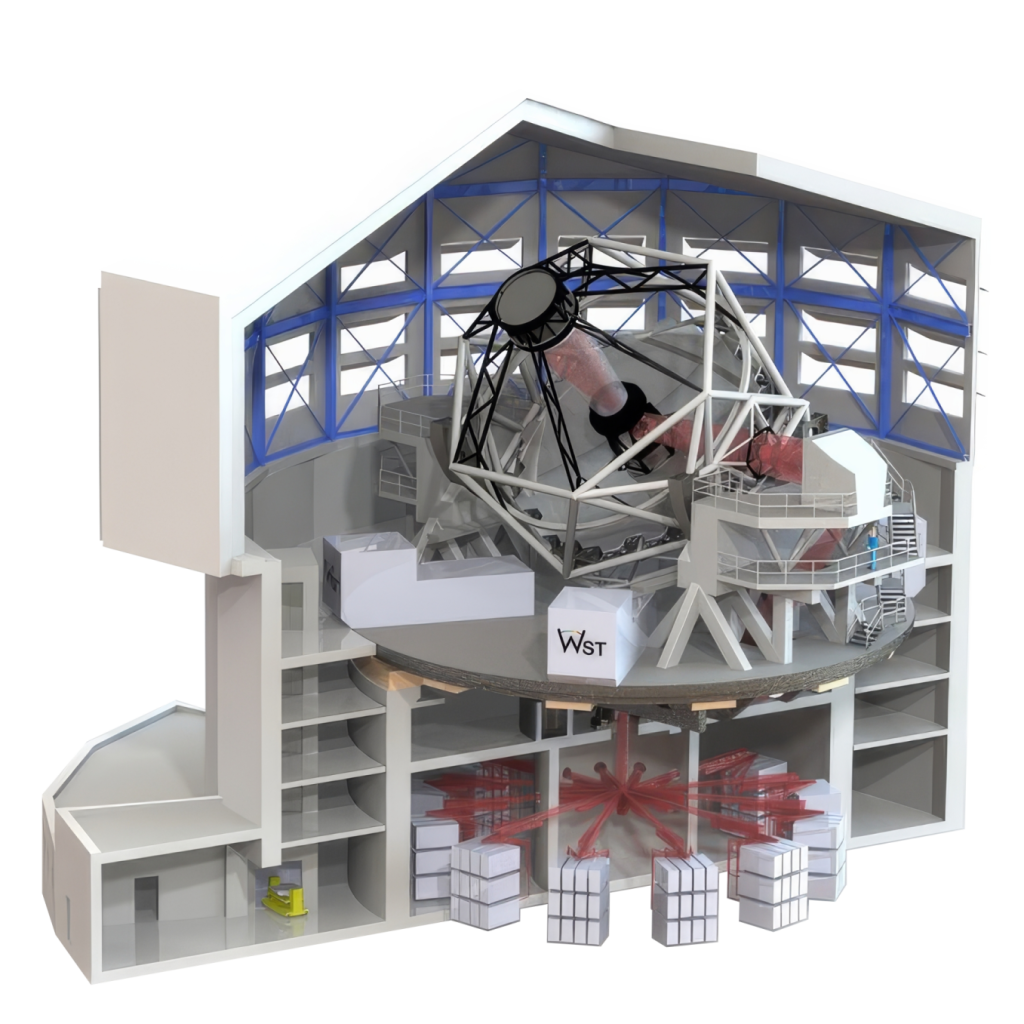
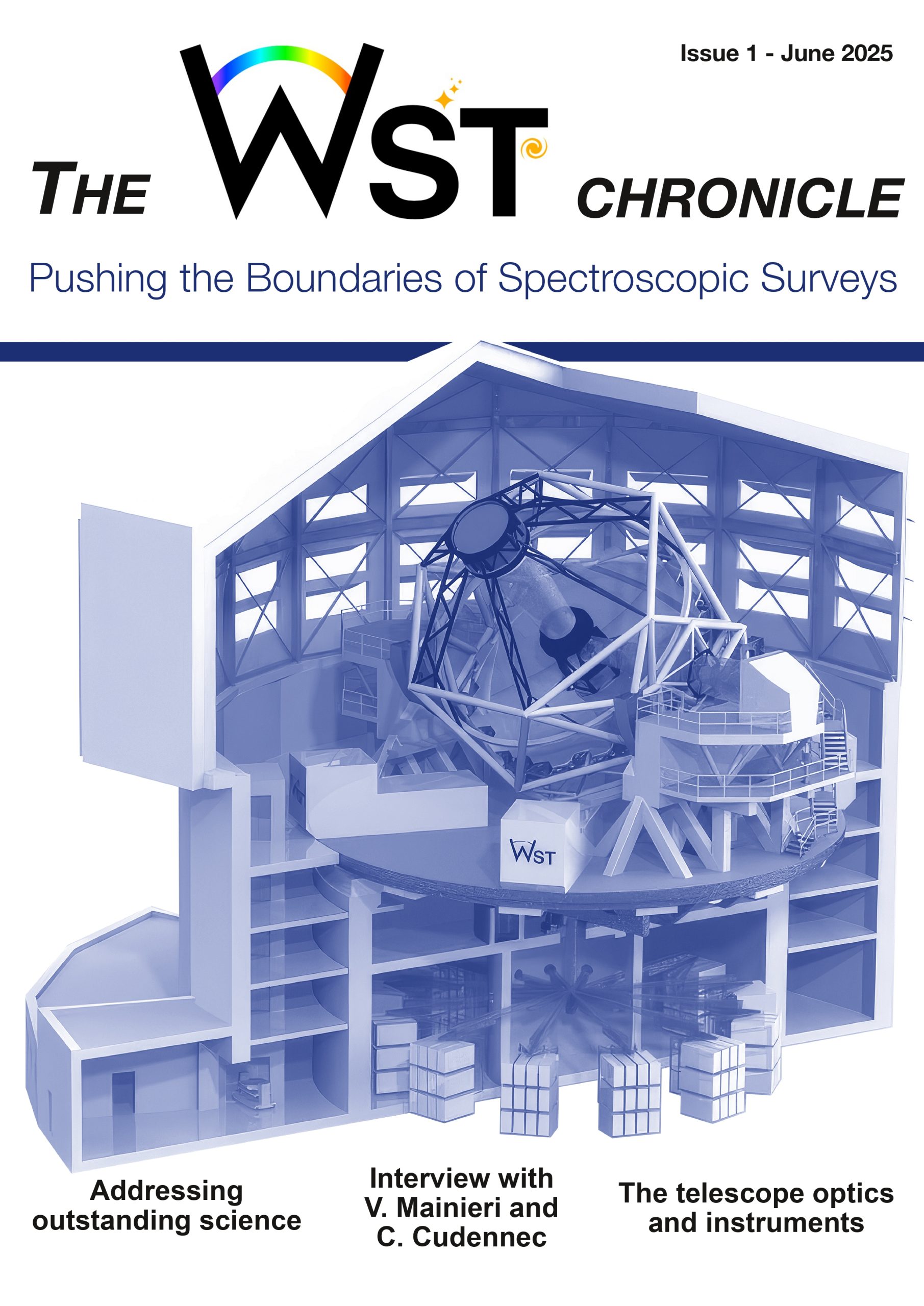
Despite the ongoing construction of ground-based telescopes with primary mirrors in the 30–40 metre class, no existing or planned facility combines the unique characteristics envisioned for the WST: a 12-metre primary mirror, the simultaneous operation of a wide-field multi-object spectrograph (MOS) covering three square degrees on the sky (approximately the area of 12 full Moons) with very high multiplexing capability (20,000 fibres), together with a giant panoramic integral field spectrograph (IFS) covering 9 square arcminutes.
“These specifications are highly ambitious and place the WST beyond existing and planned ground-based observational infrastructures. In just five years, the MOS would acquire spectra of 250 million galaxies and 25 million stars at low spectral resolution, as well as more than 2 million stars at high resolution, while the IFS would deliver 4 billion spectra, enabling a comprehensive characterisation of these sources. To put these numbers into perspective, acquiring the same 4 billion spectra would require 43 years using the IFS currently available on ESO’s VLT, or 375 years using the forthcoming 4MOST instrument to observe 250 million galaxies to the same depth,” says Roland Bacon.
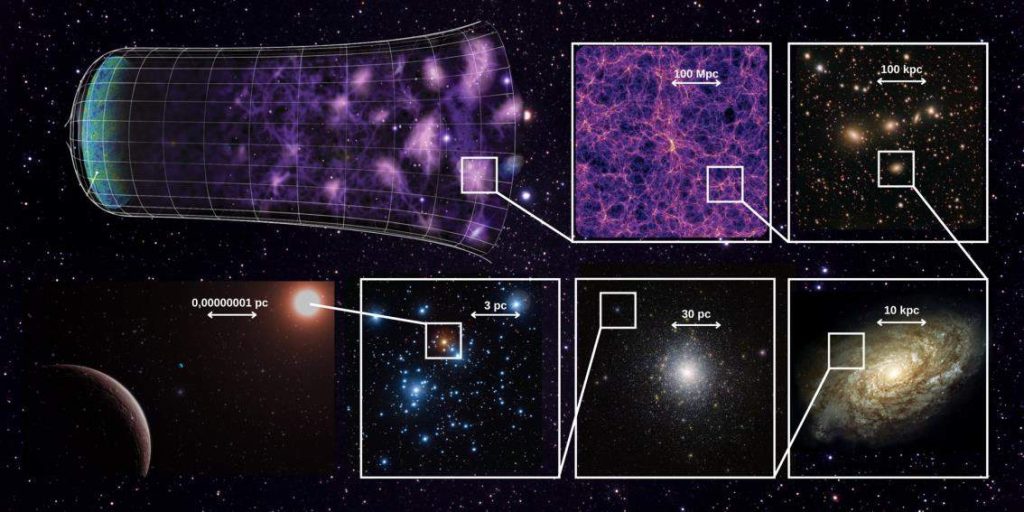
Sofia Randich adds: “The Wide-Field Spectroscopic Telescope will deliver cutting-edge, transformative science and enable researchers to address key scientific questions in areas such as cosmology; the formation, evolution, and chemical enrichment of galaxies (including the Milky Way); the origin of stars and planets; the astrophysics of transient and time-variable phenomena; and multi-messenger astrophysics.”
The Horizon Europe–funded conceptual study will address all relevant aspects required to build a complete and coherent framework for the project, including the design of the telescope and instruments, the selection of the site in Chile, the further development of the science cases, the preparation of a survey plan, and the definition of an operational model, together with plans for innovative data reduction and analysis aimed at maximising scientific return.
Special emphasis will be placed on environmental sustainability. Environmental impact will be a key criterion guiding technological choices and trade-offs, and solutions will be developed to mitigate the main sources of carbon dioxide emissions. The expected environmental impact of both the construction and operational phases of the WST will be documented in detail at the conclusion of the study.
In the near future, ESO will open a call for ideas to assess the most innovative and scientifically promising projects to be pursued after the completion of the ELT, whose first light is currently expected in 2028. If approved, the WST would become ESO’s next major infrastructure, with the potential to address some of the most transformative astrophysical questions of the 2040s.
IMAGES
The following images may be used to illustrate this topic. Please include the credits as specified: